Thursday, April 23, 2015
Vicky Pryce and Polly Toynbee in Omnibus Clapham
Polly started the evening by praising the successful launch of Omnibus in the old Clapham library, and indeed it is great to see this handsome old Victorian public building finding a new public role in the local community. It certainly adds greatly to the mix of amenities around the new Old Town piazza area.
Both speakers were critical of the Coalition government. Polly spoke of the rigidity and stealthy determination of its ideological purposes; Vicky more of the evidence-free economic policy. Although a liberal herself, she was a government economist under both New Labour and Coalition administrations, and had words of praise for New Labour at least attempting to follow the evidence. Far from having “a long herm economic plan”, the coalition choked off reviving growth and flatlined the economy for its first two years, before surreptitiously u-turning and quietly and half-heartedly loosening fiscal policy. Basically, the Tories are ideologically incapable of accepting that government investment can create growth in the wider economy.
Polly seemed more wholeheartedly to support Labour, but I liked the way she always backed up claims with independent evidence and sources. She strongly feels this is a very important election, and people should vote tactically to keep the tories out.
It was a very interesting evening, and very well attended: practically a full house.
Thursday, November 06, 2014
Fireworks over Brixton - Brockwell Park review
Monday, July 01, 2013
Weekend
Taken from the balcony of a stunning 17th-floor apartment in north London on friday evening. Night was falling but the looming clouds are deceptive - they were clearing rather than gathering:
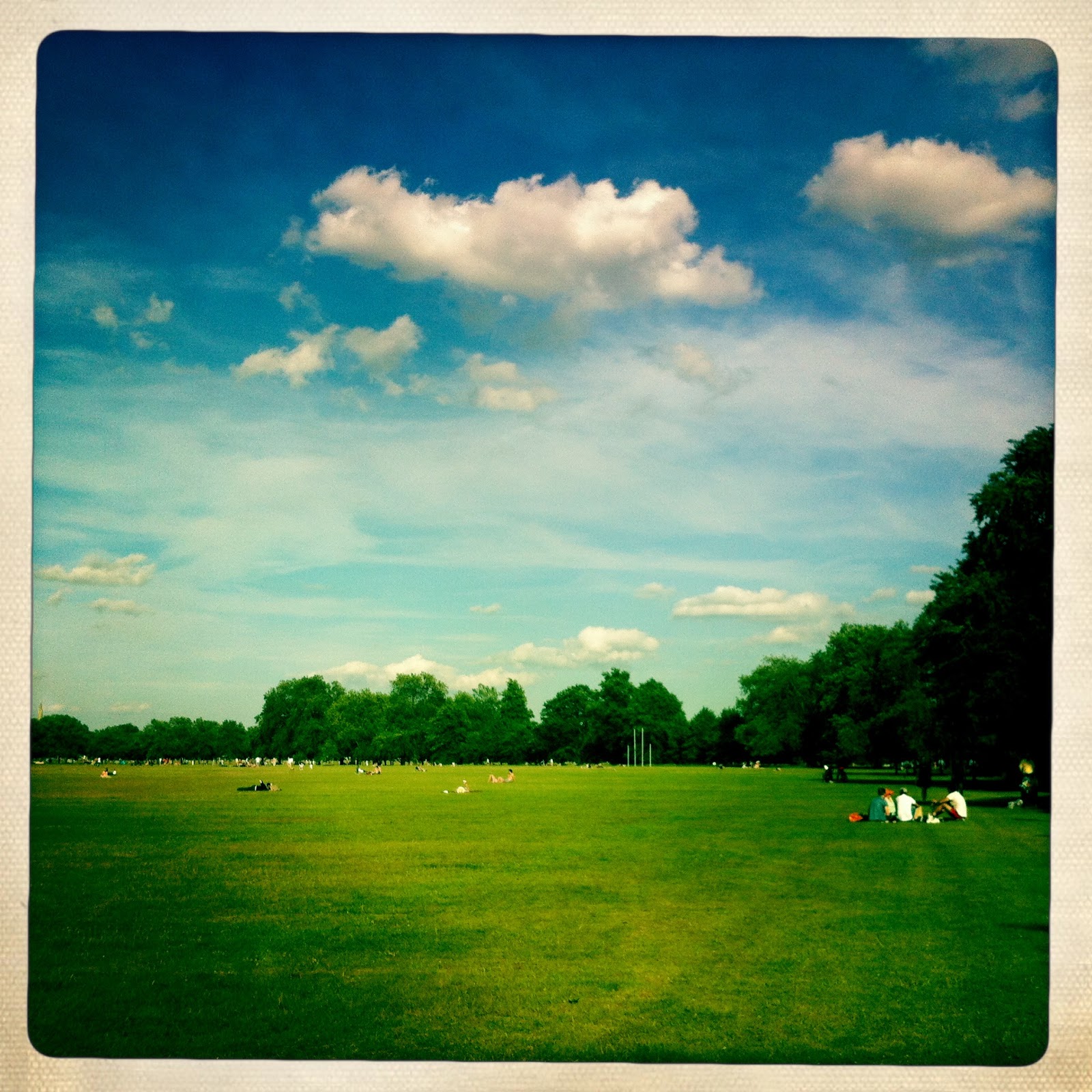
This is Clapham Common late on Sunday afternoon - flaming June finally arrived, if at the last minute.
In beween the two moments was Pride weekend, and I'll cover my Pride activities in forthcoming posts.
Monday, March 11, 2013
A London Weekend
I met my brother and sister-in-law at the Battersea Affordable Art Fair where they had just made a purchase, and we taxi’d to the finish line at Putney Bridge just as the first boats arrived.
There were around 330 boats taking part. A ‘head’ race means they aren’t all actually starting at the same time - they are let go in batches in number order, so are racing against the clock. Coxes and teams use “Cox Boxes” to monitor their progress. The race goes downstream from Chiswick to Putney (the Oxford/Cambridge race goes upstream but timed to start on an incoming tide).
It took hours though for them all to come through, and the temperature noticeably dipped throughout the afternoon. After my niece’s team sailed past (they did well and were rightly proud of their achievement in their first big race, even with a broken cox box), we supporters all repaired to The Duke’s Head pub for a very late lunch.
Thursday, February 28, 2013
Spring in Clapham
| A brilliant display of crocuses out on the Common this February - last year the early Spring was so hot it killed them off early |
![]() |
| Lambeth Council at work pruning the large Plane tree at the entrance to the Common |
![]() |
| Very neat work! |
| Meanwhile, on The Pavement, Boulevard cafe life gets into swing despite Arctic temperatures |
| The council men cleaning up after themselves |
| Industrial wood chipper in action! |
Tuesday, July 10, 2012
Clapham's New Library Opens
The flats tower above the library and the high street.
Builders are still busy completing the streetscaping at ground level - the paving does not appear at this stage to match the superlative standards of the Venn Street development.
A huge mural above the librarians' station maps out the interior space - two spirals curve out from the entrance and the desk - one upwards and the other downwards - around a central atrium rising the full height of the library space. A spiral staircase and a lift link all the levels. Books and other media line the curving spirals; reading areas, computer stations and meeting rooms lead off the spiral. The atrium houses a play space for children. It's like a mini Clapham version of Frank Lloyd Wright's Guggenheim Museum in New York
the ramp spiralling upwards
A view across the central atrium, with oculi allowing glimpses of the book stacks on the spiralling ramp
The spiral staircase
It all looks new and shiny, and the books have the feel of just having been arranged on their new shelves. Loads of users are already using the spaces - the reading and computer rooms look like they will be very popular.
Overall, the space feels modern and generous. I have some niggles with the finish, which lets the standard down - the exposed concrete ceilings look like they've been demanded by an accountant late in construction rather than originally envisaged by the architect. The librarians' space will probably need to be redesigned - it's way too small and encourages spiralling gaggles of users to besiege the poor duty librarian from all angles - while I was there fights were erupting amongst library clients (over where the queue was) and the librarians themselves appeared stressed.
Noise levels are quite high - the central atrium and hard surfaces throughout create an echoing acoustic, and the children's play area generates a large amount of noise to echo.
Wednesday, February 08, 2012
Building The Big Society
Originally uploaded by hedgiecc
CallmeDave and Boris helping out in the window of Trinity Hospice Shop, Clapham High Street
Sunday, November 06, 2011
Brockwell Park Fireworks
the financial crisis hits the fireworks displays - fireworks on Clapham Common were cancelled this year, and instead Lambeth Council plans to rotate the displays annually through the borough's parks. Fireworks will return to the Common in 2013 (if there is any money left then). This year they were held in Brockwell Park.
Brockwell has the enchanting Art Deco Lido, with its wonderful cafe, and superb views to the city - a southern version of Hampstead and Primrose Hill. Unfortunately, it does not enjoy easy access to public transport - I wonder if the Council thought of this in its planning?
I left my house at 7:10 and waited 20 minutes for the 37 bus - which arrived full to overflowing. The driver did not open his doors. My bus stop on Long Rd was crowded with people clearly waiting for the 37 only. I decided to bail out on the bus and took the tube to Brixton. No need to follow directions on a map - a vast throng of people were walking from Brixton tube to Brockwell Park.
I finally made it to the Park just as the first fireworks were let off at 8pm. They were impressive as always; quite a lift to the spirit in these chilly November evenings.
Tuesday, November 01, 2011
Halloween


Saturday, August 20, 2011
More Clapham animal history
THREE PETS
If that's not exciting enough, here is footage of an escaped lion on the loose at Clapham Junction in 1943 . . .
LION (issue title is ON THE SPOT)
Saturday, August 13, 2011
Some thoughts on the recent disturbances
A pinko liberal like me will point to the fact that the riots overwhelmingly happened in poorer areas and the rioters tended to be unemployed, and argue this must mean social deprivation and blighted prospects must be relevant to understanding the causes of these disturbances. However, it will be pointed out (correctly) that the vast majority of poor people do not riot and steal, whatever the provocation.
It is true criminality exists at all levels of society. Criminals selfishly take to enrich themselves at others’ expense, if they calculate they will get away with it. Most violent crime happens at lower levels, but as one rises in the social pecking order there are greater opportunities for non-violent crime, and for immoral acts which just tidily skirt the edges of the law. For instance, I feel there is an exact moral equivalence between MP’s looting public funds for plasma TVs on their expenses and Tottenham rioters looting Curry’s.
Peter Oborne brilliantly expands on this point:
“The culture of greed and impunity we are witnessing on our TV screens stretches right up into corporate boardrooms and the Cabinet. It embraces the police and large parts of our media. It is not just its damaged youth, but Britain itself that needs a moral reformation.”
For thirty years and more we have been told that “greed is good” (personal greed being the driver of neo-liberal economics) and we have witnessed decades of consumerist excess. We are what we consume. So now we have “shopping with violence” by those excluded from the system and a “grab what you can while you can” attitude in our politicians, businessmen and bankers.
Rupert Murdoch’s media empire, in plain sight, debauched the integrity of our political classes from Thatcher in the 80’s (who broke the rules and allowed News International to take control of The Times and Sunday Times) to just this year, when until the scandal broke the Cameron government gave every indication of breaking every sinew in order to give Murdoch the full ownership of BSkyB without legal examination.
While this trail of political corruption was there for everyone to see - most lefties have been yammering on about it for years - what shocked me was they way in which the Metropolitan Police were corrupted by News International too.
So now Britain has a superstructure of morally bankrupt politicians, police, media and bankers presiding over a rioting underclass. We truly are in dire straits.
But it seems to me the police have been corrupted from another direction too. Before she launched into her vast social engineering programme, Thatcher gave the police massive pay increases, and given the amount of social unrest during the 80s this was clearly an astute Machiavellian ploy. However, Cameron’s crew were more naively neo-liberal than the blessed Margaret and decided the police were a social expense they wanted to cut (by 20%). The strangely tentative police reaction to the start of the rioting (rioters in Clapham were left alone for hours, for example, despite prior knowledge of the intended attacks) suggests a possible intention on their part to put some pressure on the Government over the cuts; certainly the PR war between police and government in the last few days appears to support this interpretation too.
Which is another cause for alarm. Under Blair we saw an huge increase in the political import of the police - and indeed political policing. Now it could be argued the police are holding the government to ransom. I’m not a fan of Cameron at all but it is completely outrageous that the (unelected) police [service] should feel empowered to publicly argue with the elected representatives of State. I’m reading a book about the downfall of the Roman empire at the moment and it struck me we are not a million miles away from the Praetorian Guard deposing the Emperor because their pay rise wasn’t big enough.
Riots have a long history in Britain, and our beloved tv period dramas have occluded the extent of rioting in the vastly unequal Victorian and Edwardian eras. The 1886 Riot (Damages) Act allows for victims to claim compensation from the police if they were insufficiently protected. It is interesting that lawmakers of the time came up with this idea. They were clearly responding to a perceived need.
Back in those days, police and rioters were probably evenly matched in terms of technology. The 20th Century saw the police attain total dominance in technology, organization, tactics and training over potential rioters, culminating in the controversial kettling tactics of the last couple of decades.
However, we should remember the Black bloc anarchists who infiltrated the Anti-Cuts March back in March this year successfully trumped the police kettling tactics. The black bloc people ran amock in small groups throughout the city, popping up all over to cause havoc, then melting away only to reappear elsewhere. No black blocs were arrested, despite them being the major perpetrators of political violence that day. Instead, the police chose to arrest around 300 entirely peaceful UK Uncut protestors staging a sit-in in Fortnum & Masons (highlighting Fortnum’s non-payment of UK tax). These arrests were massive headline news at the time. Subsequently, all charges against everyone arrested there were dropped.
Clearly, those arrests formed a PR mask for police failure, and the current riots demonstrate anarchist black bloc tactics have by osmosis been absorbed by criminal elements intent on looting, with similar expectations of success. The only successful police response to this was an eventual massive increase in manpower on the streets - 16,000 on the streets of London this week, more than ever in history and three times more than usual. This is not sustainable long-term and police will be thinking of new tactics to contain rioters.
But until new, successful and cost-effective tactics are developed, and underlying social injustices are addressed, I expect to see more events of this kind. The initial riots were copied very quickly and very widely. Until then we will have to suffer populism of the “ban twitter and facebook” kind, even though it could be argued tv news coverage poured more petrol on the flames than social media ever did.
Wednesday, July 27, 2011
Clapham History: Murder and Fashion
In the early 50s Londoners were still overcoming the legacy of World War II, with austerity still casting a baleful pall. Gangs of youths in South London started to adopt a flamboyant style of dress in rebellion against the depressing drabness. Apparently, they were inspired by upscale west end gay fashionistas. The look was flash and expensive.
On the evening of the 2nd July 1953 a fracas started near Clapham Common bandstand and spilled over to North Side, where two lads were dragged off the 137 bus and one of them, John Beckley, was fatally stabbed. The gang wore the cutting-edge fashionable teenage costume which referenced Edwardian style - newspapers found the word too long for headlines so shortened it to "Teddy" and the Teddy Boys were born.
Read Another Nickel in the Machine's great post on this incident.
Friday, June 17, 2011
New in Clapham
The new Library Building on Clapham High Street is shooting up and is due for completion in September this year. Very exciting, as we'll have a brand new library and swimming pool here in SW4. The developers get 136 new apartments to flog, to help pay for the public amenities.
You won't find any information on the website about the new civic facilities, just a rather crass commercial hard sell. However, the relentless, hysterical grip on its target demographic is rather amusing:
[Edit: video now removed as too annoying!}
No grannies need apply!
I suppose the target punters will be shocked to find such an archaic insitution as a library in the basement. They may enjoy the swimming pool, however. It will be interesting to see how public and private interact as the building comes to life.
'The New" is actually so old - such a watered-down, pale pastiche of Frank Gehry's oeurvre, an architect whose style, so amazing in the 90s, is already slipping into the past. Do we deserve better public buildings? I suppose the rather magnificent Battersea Library extension was also architecturally retrogressive when it was built in the 1920s. It was however proud to be a library.
Thursday, May 05, 2011
An Ancient Roman Altar in Clapham

According to records, this inscribed Roman altar stone was discovered during building operations at Clapham Common South Side in 1912. It was erected by Vitus Ticinius Ascanius, probably in the first century AD. Clapham High Street and Abbeyville Road were Roman Roads (heading towards Chichester) so the Romans were active in these parts but it is nce to have hard physical proof that they were in the neighbourhood almost 2,000 years ago.
It has now been re-erected outside Clapham Old Town public library. I've been going here for years but not noticed it before! (However, in my defence it is behind a heavy iron railing and almost hidden under a hedge and shrub). The inscription is very faint.
By complete coincidence I came across the English Heritage records last night, and as today was voting day in the Alternatve Vote referendum I kept a look out for it when I went to vote :)I was the only one there at lunch time! - voter apathy rules supreme. As I write this, there is still some time to get to the polling station and vote if you haven't already. Despite all the cycnicism engendered by the behaviour our current crop of politicians, this is actually an opportinity to change our democracy for the better. :)
Tuesday, April 12, 2011
Graham Greene lived here!
Originally uploaded by hedgiecc
No. 14 Clapham Common North Side
The novelist received an official blue plaque from English Heritage last week.
"Graham Greene (1904-1991) lived at 14 Clapham Common North Side from 1935 until he was forced to leave the house due to war damage in 1940. His novel The End of the Affair is set in Clapham in 1945-6. The narrator lives in a bedsit 'at the wrong side of the Common' (South Side), drinks in the 'Pontefract Arms' (The Windmill) and visits 'the dark church at the corner of Park Road - a Roman Catholic church full of plaster statues' (St Mary's).
Writing to his mother, Greene describes Clapham thus: 'the whole appearance of Clapham Common is lovely, like a wide green plateau on a hilltop above Battersea with the Common stretching out in one direction and on three sides surrounded by little country-like shops and Queen Anne houses."
- from Clapham Past by Gillian Clegg
Greene lived here with his family from August 1935 to October 1940, when the house was bombed.
"The English Heritage blue plaque will be installed at 14 Clapham Common North Side, where Greene lived with his family from August 1935; at that time he described it as “a most beautiful Queen Anne house … done up absolutely like a museum piece”. It remained his home until October 1940 when it was hit in a bombing raid and became uninhabitable; the house was empty that night as Vivien and the children had been evacuated to Sussex and Graham was staying in Bloomsbury with his lover, Dorothy Glover. This devastating event later inspired the pivotal point in his novel, The End of the Affair. Despite the damage, the outer walls of the house remained intact, allowing the interior to be rebuilt after the war. The house is Grade II* listed and forms part of a terrace built by the architect John Hutt in 1714-20.
Greene’s daughter, Caroline Bourget, said of the house: ".... my father evacuated us to his parents' home in Sussex in August 1939 when I was only 5 yrs old......but I do remember the magnificent staircase. Some well-known writers and publishers visited the house such as John Betjeman and Evelyn Waugh. When I met them later, they recalled seeing me at the age of 3 or 4."
English Heritage blue plaque historian Dr Susan Skedd said: “Graham Greene is indisputably one of the great British writers of the twentieth century. He achieved the rare distinction of enjoying both critical and popular admiration throughout his career. Since the centenary of his birth in 2004 his literary reputation has been increasing and we hope this plaque will act as a focus for old and new fans of his work alike.”
Monday, February 14, 2011
Happy Valentine's Day!

Love is a four letter word: cakes from Konditor and Cook in Borough Market
Ceramic Valentines from North Street Potters, Clapham
You know you want me: cards from Scribbler, branches all over London
Wednesday, July 28, 2010
A cucumber grows in Clapham
Sunday, June 20, 2010
Adventures in Wonderland

Alice arrived in a Clapham wonderland earlier this month as Trinity Hospice welcomed Londoners to its garden open day in aid of the NGS.

The afternoon was themed as an ‘Alice in Wonderland’ family fun-day with entertainers, including magicians and costumed stilt walkers for children, stalls to browse and drinks and light refreshments. All in the setting of the magical and beautiful English country style gardens.