Back to the King's Head for this very interesting revival of Colin Spencer's Spitting Image - the first openly gay play performed in the UK back in 1968 after the decriminalisation of homosexuality and (presumably) the relaxation of theatre censorship, and never since revived.
It played for two months to packed houses at the Hampstead Theatre (greeted with much tutting by the Evening Standard), and transferred to the West End. In the disapproving atmosphere of the times however, the play could not find a publisher, and disappeared. It's amazing that Adam Spreadbury-Maher, artistic director of the King's Head, discovered a script in the Oscar Lewenstein theatre archive at the V&A Museum, and hence this revival was possible.
One half of a gay couple falls pregnant and the play explores the consequences both for their relationship and in society. What is amazing is at the time it was written the idea of gay couples bringing up children was totally unthought of - the play uses it as a metaphor for coming out - but now of course in the era of gay marriage it's pretty topical.
Spitting Image's giddy and surreal social satire sits well in the context of Orton and Stoppard. I actually thought the satirical element worked best - the couple squabbling over dirty nappies and relationship issues less so. The huge concern the play demonstrates over crushing state surveillance is sadly right up-to-date. Nothing's changed there.
The acting was all on point and brought out all the fun of the piece. The set design aimed for minimalism but actually was quite tricksy and distracting with actors having to carry props on and off awkwardly all the time. At least in the first half Sally Ambrose entertained us while this was happening with her groovy 60's dance moves. In the second half she became a character in her own right, mooning after Alan Grant's Gary, the gay man struggling against the odds to keep his relationship and child.
Friday, September 02, 2016

Thursday, September 01, 2016
Tribal Art London

I dropped in to have a look and here are a few of the things that caught my eye. First of all, obviously, some African masks:


Finally, this Ethiopian headrest I thought was striking in its beautiful shape and patina, with highly intriguing metallic adornments and repairs.

Tuesday, August 30, 2016
Cut Throat / Camden Fringe

Cut Throat by Jean-Philippe Baril Guerard as adapted by Matt
Cunningham. – London Irish Centre
I caught this play on the penultimate night a week ago now, so this
is a quick late review.
The publicity promised:
"How far can you go in the name of free speech?
Does having the right to speak equal having the right to say everything?
In Cut Throat, the right to speak does not come with a promise that the speech be valid or harmless.
14 characters speak their minds freely about race, religion, relationships, bodies, sex, money, and the meaning of life, without any filter, walking the thin line between comedy and cruelty. An irreverent play that will make you laugh... and cringe."
This was a relatively short, intense play with 14 characters, so
nevertheless quite ambitious as the first production by Trip and Guts Theatre.
The play takes the form of a series of monologues or largely one-sided two-or
three part scenes (mostly loosely unrelated in terms of 'plot' but clearly
related thematically). The audience sits around four sides of a square, and the
actors pop out from the audience's ranks to perform their roles.
All the actors played their parts with evident relish and panache,
and the very wordy play cracks on at a great pace. Stand outs amongst a strong
cast for me were Joseph Rain-Varzaneh as the mugger and Hannah Wilder as the
long-suffering Usher - one of the shortest spoken roles but she appears
throughout the piece as the long-suffering innocent target of the other
characters' nastiness. I can see why this play would appeal to actors -
firstly, each character gets a lot to say and is completely central whilst they
say it, each character has an internal dramatic tension to reveal as the 'real'
inner person breaks through an initial 'polite' or politically-correct outer
shell; and there is external drama in each mini situation too.
We saw this play on the back of Chemsex Monologues, also created
(obviously) around monologues. Monologues are an interesting theatrical device,
notably introduced by Shakespeare to reveal a character's innermost thoughts.
They are at once the most artificial of constructs, breaking any feel of
'realism' on stage but simultaneously the most powerful and direct
communication between actor and audience there can be - really harking back to
ground zero of narration - speaker to listener. There is a tendency in a
monologue for an actor to reach for a kind of declamatory style, which we
thought a bit difficult in Chemsex but this works strongly in Cut Throat. I
think this is because Chemsex the play has realistic fundamental assumptions -
the play is about 'real' characters and plot whereas Cut Throat skews more
conceptual. The characters are very far from realistic, are usually quite easily
identifiable stock contemporary types
- and each scene and character unfolds in a similar way, repeating the
themes of the play almost like an abstract pattern until the climax. My
favourite character, the mugger, is completely surreal, made up as he is of
bravura flights of literary language and philosophy completely alien I would
imagine to any real mugger.
Altogether, a most stimulating evening.
Saturday, August 20, 2016
The Chemsex Monologues

It's not often one hears of an actor playing two roles in different plays at the same time - however, for the last week you could catch Denholm Spurr as Damien/Jean Baptiste in 'The Past is a Tattooed Sailor' by Simon Blow at the Old Red Lion Theatre (through to 27 August) and Nameless in 'The Chemsex Monologues' by Patrick Cash at The King's Head Theatre (last performance tonight).
In fact, make that three roles! (Two different ones in the same play.)
One can only applaud Spurr's energy, commitment and enthusiasm in taking his final bows (after a two hours + performance) at the Old Red Lion and then dashing up Upper Street to The King's Head to don his makeup for Nameless. It would have been fun to catch both performances in a marathon night of theatre, but we took things much more sedately, catching Sailor last weekend (review here) and Chemsex last night after a quick dinner at Belanger on Islington Green.
They are both new gay plays by gay authors performed in pub theatres in Islington simultaneously, but that is where the similarities end.
Sailor is an expansive, nostalgic, traditionally-structured piece whereas Chemsex is much more contemporary in focus and experimental in form. Four narrators appear in sequence with monologues from their individual perspectives on their relationship with Nameless and his story. The audience pieces together Nameless's situation from each fragment - each narrative is slightly unreliable due to their tangential relation to Nameless and the plot line and each character is wrapped up in their own concerns.
This structure gives a sense of urban anonymity and alienation, but also creates a considerable amount of suspense as we follow Nameless's story to its climax. The total separation of the actors also serves to heighten the pathos of Nameless's descent.
The acting was all good, which was so important here when you can't talk of an ensemble. Richard Watkins plays the Narrator - an 'Everygay' sort of character who bookends the play - with breezy charm. Charly Flight is Fag Hag Cath - amusing but very warm and human. Matthew Hodson plays Daniel the Sexual Health Worker - again, a lovable doofus doing his innocent best, a very heart-warming performance. Denholm Spurr's Nameless is the heart of the play and he gives it a terrific performance moving smoothly from humour to the emotional depths.
An urgent and well-considered piece of contemporary theatre; I'm really pleased to have caught it.
Friday, August 19, 2016
The Plough and the Stars

Confession time - I have never seen a Sean O'Casey play performed; nor have I read one. I usually tend to avoid overtly political drama.
However, as 2016 is the 100th anniversary of the Easter uprising I decided to honour my Irish ancestry and indulge my literary curiosity by seeing this revival at the National Theatre (itself mounted to mark the occasion, playing until 22 October 2016).
Reviews have been a bit mixed, so I took my seat with some trepidation. However, I was soon sucked into the world of the Clitheroes' Dublin tenement. This is really a full-blooded, lushly romantic and visually very beautiful production of a traditionally-structured drama. The politics of the play are sophisticated and rooted in the frailty of human character - O'Casey pulls no punches with the British army's occupation and artillery bombardment of Dublin but he is equally harsh on the shortcomings of the nationalists and totally mocks the pretensions of the play's socialist. Nevertheless, O'Casey was a socialist himself and demonstrates a sympathy with all the individual characters - even the British Tommies when they appear are decent blokes who would rather have a cup of tea - and instead he shows how they are all individually trapped in unequal and exploitative social conditions.
It is true that the actors do have varied degrees of success and consistency with their accents, and that some words are difficult to hear. The play is very literary and 'wordy' though, and the directors Howard Davies and Jeremy Herrin were probably wise to sacrifice pockets of legibility in favour of pushing the pace and drama overall.
What charmed me immediately was O'Casey's dexterity in the dramatic arts of foreshadowing, parallelism and contrasting. We first see Nora, the wife of a bricklaying Commandant in the Irish Citizen Army setting a table for tea; in the last act she sets it again in hugely different circumstances with a tragic outcome. In the second act there is a massive contrast between a political meeting outside a pub and the comic antics of a prostitute inside (this caused a riot at the play's premiere in Dublin). The third act, set in the street outside the tenement, starts off emphasising the poignancy of the characters' extreme poverty (Little Mollser clearly on the point of death from Tuberculosis); moves into the broad comedy of everyone looting when the British start to shell the city; followed ominously by the Irish Nationalist fighters with a severely wounded comrade escaping the inexorable British advance; and ending with the crisis between Nora and her husband, with the British soldiers very near. British soldiers make their physical entrance in the fourth act, and despite the horror of British military action the individuals themselves are ordinary guys just doing their job.
From today's perspective one could probably accuse the play of a kind of poverty porn (much played up by designer Vicky Mortimer's exquisite sets) - but on the other hand this is a function of the time it was written in. And surely it is so much more preferable to the Chav-bashing "Benefits Street"-style propaganda of today.
There are excellent performances from the female leads in particular - Justine Mitchell as Bessie Burgess and Judith Roddy as Nora Clitheroe are beautiful, poetic and tragic. Josie Walker as Mrs Grogan is funny and heart-warming; and Gráinne Keenan (Rosie Redmond) and Róisín O'Neill (Little Mollser) shine in smaller roles.
Sunday, August 07, 2016
The Past is a Tattooed Sailor

It’s always pretty exciting to see new work, and a first play by a neophyte playwright.
Joshua, a posh but poor aspirant writer (Jojo Macari), seeks to create a closer relationship with his great-uncle Napier, a bed-ridden ex-social butterfly and fading beauty shut up in his country mansion and living only through reminiscences of his past success amongst the social and artistic elite, as well as his raunchy liaisons with French sailors in Marseilles. Napier’s penchant for rough trade is shared with Joshua, who has a builder’s mate boyfriend Damien (Denholm Spurr) - shared quite literally as the bed-ridden Napier nevertheless craftily manages to put the moves on Damien.
There is good material in Tattooed Sailor, and an intriguing premise, but I felt the writing could have benefitted from further work editing and refining purpose and dramatic direction. I sense a number of unresolved issues in the writer’s emotional responses to these autobiographical events, which sadly accrue around the leading character Joshua, the cornerstone of the entire play: weaknesses in the construction of this character impact the whole piece. Macari struggles manfully with this underwritten and confused role.
Bernard O’Sullivan and Nick Finegan are evocative, stylish and affecting as the older and younger Napiers - Finegan especially evokes the authentic note of a 1930s Bohemian dandy and rake and contrasts pleasingly with the more contemporary Joshua and Damien. Denholm Spurr exudes an effortless animal sensuality and displays rampant sexual chemistry with all three of the other leads - in French too as the titular tattooed sailor in a tryst with the younger Napier.
Overall, this play held my attention and I did enjoy the experience, with the caveat that I ended with feeling a much stronger play is hidden deep within.
Saturday, February 06, 2016
The Winter's Tale
An ‘authentic’ performance in an historically-correct as-we-can-make-it Renaissance theatre could perhaps be a dry, academic affair but I emerged last night from the Sam Wannamaker Playhouse reeling. The visceral drama caused me to question if our contemporary theatre, whether with proscenia or without, with its powerful electric lighting and with all the artifice that modern technology can conjure, is not a waxwork effigy of what REAL drama can be. I’ve emerged confusedly pondering that drama does not depend on faultless sight lines and the most comfortable seats to experience the actors’ art. I had a great seat for Cymbeline in the same space - but I realised then conventional understanding of what a great seat is does not really apply to this space, so I was happy to try a very poor seat this time right up in the gods for The Winter’s Tale.
At first, I was disappointed. I was right at the back on a diagonal to the stage - so I had a seat with a back rest (bench seating otherwise pretty much throughout). I knew the pillar advertised to hamper sight lines was a small slender thing which wouldn’t bother me much but what I hadn’t realised was that the two rows of back-rest-free people sitting in front of me would lean forward. If you are unlucky enough to have a lady with a big hair do in front, that’s half the stage gone, and the pillar takes maybe another 10%. You are up at a very vertiginous rake to the stage, and peering down on top of the actors’ heads through glaring chandeliers. It is surprising just how much light 6 large chandeliers emit - however, even so, its quite dim on stage and even though this is a tiny space and the actors are relatively close you won’t really see their every facial expression very clearly in the golden glow.
However, you will hear even their whispers crystal clear. This space has an amazingly intimate acoustic (all that wood). And although there is a distinct stage area, it feels seamlessly part of the entire space - the audience very much feels physically and emotionally included in the actors’ world. This was particularly true of the trial scene, where Leontes appealed to us as the judges.
Candlelight itself creates an intimate atmosphere which enhances the emotional effect of the performance. This is what weirded me out - I realise our contemporary way of presenting theatre privileges the visual senses of the audience - and in fact bludgeons the eyes by maybe making things too easy to see. The visual restrictions of Renaissance theatre and its candle lighting force one perhaps to use one’s other senses and imagination more and encourage an active emotional participation.
The scene opens in Leontes’ court in Sicilia - as bright as can be, with all the courtiers dressed in white, and with Leontes himself in a gorgeous white doublet with metallic embroidery sparkling in the candlelight. I really admired John Light’s frighteningly rapid descent into psychotic violent jealousy. Rachael Stirling’s graciously statuesque Hermione at first is oblivious to her husband’s suspicions, then is falsely accused and piteously ends up in the trial scene in chains and dirty rags.
By this stage Leontes’s jealous madness has destroyed his entire family: he has broken with his life-long best friend, his son is dead of grief for his mother, Hermione herself has been humiliated in a show trial and has died, and her new-born baby is sent by the king to be exposed in a barren place. All his courtiers fear the king as a tyrant: only the feisty Paulina (brilliantly played by Niamh Cusack) bravely speaks truth to power.
The prison and trial scenes bring the first coups de théâtre. The lights at the opening are all gracious twinkling chandeliers. In the prison scene the chandeliers are all raised high (darkening the stage) and gaolers and prison visitors use braziers and lanterns. The braziers in particular feel rough and crude - visually echoing the King’s madness and the tragic turn of events. Characters are in dark cloaks now, and clever choreography with cloaks and hand-held lanterns throw up stunning effects of light and dark - strongly expressive faces and arms are lit up like a Caravaggio brought to life. Paulina’s and Leontes’ disputes in these scenes are particularly well emphasised.
And then, after the emotional storm of the trial, the chandeliers are all extinguished and the smoking stubs raised swiftly up high - the swinging, eerily smoking chandeliers , together with sound effects, marvellously evoke a storm at sea and on the dangerous coast of Bohemia.
This scene is played in the most complete darkness I have ever experienced in a theatre. We all know what happens next - “exit pursued by a bear” - and this production very nicely extends the tension to its maximum. Antigonus’s wildly swinging lantern is now the only source of light in the entire theatre, and throws careering, pitch black shadows everywhere.
And then after the descent into compete darkness and “the gap of time”, we open up into the light again. Extra chandeliers are lowered onto the shepherds’ festival celebrations, and even a fully blazing fire is carried on stage. Perdita, now fully grown, dances in her dazzling robes and veils with her prince Florizel to the minstrel’s music as if there was no fire hazard. I liked the music, singing and dancing in Bohemia very much: natural and fresh, it is completely organic with the environment and play. Prop’s to Steffan Donnelly’s Florizel - a capering, enthusuastic, slightly immature but very honourable and genial sort of chap. Also one must mention the extraordinary dance of the satyrs. Pagan, oddly disturbing and erotic. The comedic antics of the old shepherd, the clown and Autolycis also lighten the mood and prepare for the reconciliation scene ahead.
John Light pitches Leonte’s remorse just right in the final scene. It’s strange how odd this play reads as text with the king’s rapid emotional reverses but performed well the emotions work perfectly as drama and are believably human. Hermione is restored to us as the gracious queen we saw in Act 1. The play ends, as it opened, with the king kissing the queen.
This is a stunning, fresh and powerful reading of the play in an extraordinary and unique environment. I would urge you to see it if you can get tickets.
The Winter's Tale
Sam Wannamaker Playhouse
Shakespeare's Globe, London
October 2015 - April 2016
At first, I was disappointed. I was right at the back on a diagonal to the stage - so I had a seat with a back rest (bench seating otherwise pretty much throughout). I knew the pillar advertised to hamper sight lines was a small slender thing which wouldn’t bother me much but what I hadn’t realised was that the two rows of back-rest-free people sitting in front of me would lean forward. If you are unlucky enough to have a lady with a big hair do in front, that’s half the stage gone, and the pillar takes maybe another 10%. You are up at a very vertiginous rake to the stage, and peering down on top of the actors’ heads through glaring chandeliers. It is surprising just how much light 6 large chandeliers emit - however, even so, its quite dim on stage and even though this is a tiny space and the actors are relatively close you won’t really see their every facial expression very clearly in the golden glow.
However, you will hear even their whispers crystal clear. This space has an amazingly intimate acoustic (all that wood). And although there is a distinct stage area, it feels seamlessly part of the entire space - the audience very much feels physically and emotionally included in the actors’ world. This was particularly true of the trial scene, where Leontes appealed to us as the judges.
Candlelight itself creates an intimate atmosphere which enhances the emotional effect of the performance. This is what weirded me out - I realise our contemporary way of presenting theatre privileges the visual senses of the audience - and in fact bludgeons the eyes by maybe making things too easy to see. The visual restrictions of Renaissance theatre and its candle lighting force one perhaps to use one’s other senses and imagination more and encourage an active emotional participation.
The scene opens in Leontes’ court in Sicilia - as bright as can be, with all the courtiers dressed in white, and with Leontes himself in a gorgeous white doublet with metallic embroidery sparkling in the candlelight. I really admired John Light’s frighteningly rapid descent into psychotic violent jealousy. Rachael Stirling’s graciously statuesque Hermione at first is oblivious to her husband’s suspicions, then is falsely accused and piteously ends up in the trial scene in chains and dirty rags.
By this stage Leontes’s jealous madness has destroyed his entire family: he has broken with his life-long best friend, his son is dead of grief for his mother, Hermione herself has been humiliated in a show trial and has died, and her new-born baby is sent by the king to be exposed in a barren place. All his courtiers fear the king as a tyrant: only the feisty Paulina (brilliantly played by Niamh Cusack) bravely speaks truth to power.
The prison and trial scenes bring the first coups de théâtre. The lights at the opening are all gracious twinkling chandeliers. In the prison scene the chandeliers are all raised high (darkening the stage) and gaolers and prison visitors use braziers and lanterns. The braziers in particular feel rough and crude - visually echoing the King’s madness and the tragic turn of events. Characters are in dark cloaks now, and clever choreography with cloaks and hand-held lanterns throw up stunning effects of light and dark - strongly expressive faces and arms are lit up like a Caravaggio brought to life. Paulina’s and Leontes’ disputes in these scenes are particularly well emphasised.
And then, after the emotional storm of the trial, the chandeliers are all extinguished and the smoking stubs raised swiftly up high - the swinging, eerily smoking chandeliers , together with sound effects, marvellously evoke a storm at sea and on the dangerous coast of Bohemia.
This scene is played in the most complete darkness I have ever experienced in a theatre. We all know what happens next - “exit pursued by a bear” - and this production very nicely extends the tension to its maximum. Antigonus’s wildly swinging lantern is now the only source of light in the entire theatre, and throws careering, pitch black shadows everywhere.
And then after the descent into compete darkness and “the gap of time”, we open up into the light again. Extra chandeliers are lowered onto the shepherds’ festival celebrations, and even a fully blazing fire is carried on stage. Perdita, now fully grown, dances in her dazzling robes and veils with her prince Florizel to the minstrel’s music as if there was no fire hazard. I liked the music, singing and dancing in Bohemia very much: natural and fresh, it is completely organic with the environment and play. Prop’s to Steffan Donnelly’s Florizel - a capering, enthusuastic, slightly immature but very honourable and genial sort of chap. Also one must mention the extraordinary dance of the satyrs. Pagan, oddly disturbing and erotic. The comedic antics of the old shepherd, the clown and Autolycis also lighten the mood and prepare for the reconciliation scene ahead.
John Light pitches Leonte’s remorse just right in the final scene. It’s strange how odd this play reads as text with the king’s rapid emotional reverses but performed well the emotions work perfectly as drama and are believably human. Hermione is restored to us as the gracious queen we saw in Act 1. The play ends, as it opened, with the king kissing the queen.
This is a stunning, fresh and powerful reading of the play in an extraordinary and unique environment. I would urge you to see it if you can get tickets.
The Winter's Tale
Sam Wannamaker Playhouse
Shakespeare's Globe, London
October 2015 - April 2016
Sunday, November 01, 2015
Quote London
“A sprawling North London parkland, composed of oaks, willows and chestnuts, yews and sycamores, the beech and the birch; that encompasses the city’s highest point and spreads far beyond it; that is so well planted it feels unplanned; that is not the country but is no more a garden than Yellowstone; that has a shade of green for every possible felicitation of light; that paints itself in russets and ambers in autumn, canary-yellow in the splashy spring; with tickling bush grass to hide teenage lovers and joint smokers, broad oaks for brave men to kiss against, mown meadows for summer ball games, hills for kites, ponds for hippies, an icy lido for old men with strong constitutions, mean llamas for mean children and, for the tourists, a country house, its façade painted white enough for any Hollywood close-up, complete with a tea room, although anything you buy there should be eaten outside with the grass beneath your toes, sitting under the magnolia tree, letting the white blossoms, blush-pink at their tips, fall all around you. Hampstead Heath! Glory of London! Where Keats walked and Jarman fucked, where Orwell exercised his weakened lungs and Constable never failed to find something holy.”
- Zadie Smith, On Beauty
Thursday, April 23, 2015
Vicky Pryce and Polly Toynbee in Omnibus Clapham
The economist Vicky Price and Guardian columnist Polly Toynbee are or were both long-term residents of Clapham, and appeared together last night at Omnibus to discuss their new books: It’s the Economy Stupid by Vicky Pryce, Peter Unwin and Andy Ross and Cameron’s Coup by Polly Toynbee and David Walker. The event was co-hosted by Clapham Books - it’s great to see collaboration of this sort between our local independent bookshop and Omnibus.
 Polly started the evening by praising the successful launch of Omnibus in the old Clapham library, and indeed it is great to see this handsome old Victorian public building finding a new public role in the local community. It certainly adds greatly to the mix of amenities around the new Old Town piazza area.
Both speakers were critical of the Coalition government. Polly spoke of the rigidity and stealthy determination of its ideological purposes; Vicky more of the evidence-free economic policy. Although a liberal herself, she was a government economist under both New Labour and Coalition administrations, and had words of praise for New Labour at least attempting to follow the evidence. Far from having “a long herm economic plan”, the coalition choked off reviving growth and flatlined the economy for its first two years, before surreptitiously u-turning and quietly and half-heartedly loosening fiscal policy. Basically, the Tories are ideologically incapable of accepting that government investment can create growth in the wider economy.
Polly seemed more wholeheartedly to support Labour, but I liked the way she always backed up claims with independent evidence and sources. She strongly feels this is a very important election, and people should vote tactically to keep the tories out.
It was a very interesting evening, and very well attended: practically a full house.
Both speakers were critical of the Coalition government. Polly spoke of the rigidity and stealthy determination of its ideological purposes; Vicky more of the evidence-free economic policy. Although a liberal herself, she was a government economist under both New Labour and Coalition administrations, and had words of praise for New Labour at least attempting to follow the evidence. Far from having “a long herm economic plan”, the coalition choked off reviving growth and flatlined the economy for its first two years, before surreptitiously u-turning and quietly and half-heartedly loosening fiscal policy. Basically, the Tories are ideologically incapable of accepting that government investment can create growth in the wider economy.
Polly seemed more wholeheartedly to support Labour, but I liked the way she always backed up claims with independent evidence and sources. She strongly feels this is a very important election, and people should vote tactically to keep the tories out.
It was a very interesting evening, and very well attended: practically a full house.
Saturday, January 31, 2015
Quote London - Stockwell Watchmen
It seems north Londoners have always felt a little bit nervous of security arrangements south of the river - I was mildly amused to come across this diary entry by Joshua Wingate Weeks for 30 January 1779:
The security state has had a long history!
(Quote from A London Year: 365 Days of City Life in Diaries, Journals and Letters, compiled by Travis Elborough & Nick Rennison. Published by Frances Lincoln, 2013)
"When the service was finished I took a walk on the other side of the river into the country as far as Stockwell which is a small village about 4 miles from London ... Vauxhall Gardens are also here, which we passed by. We dined at Stockwell & returned home by another road. It was late in the evening & the lamps which extended from London to this place were lighted & formed a most august and beautiful appearance. At small distances watchmen armed with musquets are placed to prevent mischief & detect robberies & they have bells placed in such a manner as to give notice to each other by ringing them if any thing remarkable occurs, by which means they could readily come to each others assistance & be upon their guard to prevent the escape of any suspected person."
The security state has had a long history!
(Quote from A London Year: 365 Days of City Life in Diaries, Journals and Letters, compiled by Travis Elborough & Nick Rennison. Published by Frances Lincoln, 2013)
Thursday, November 06, 2014
Fireworks over Brixton - Brockwell Park review

I really loved the way Lambeth always provided a free fireworks show for residents every year. Although obviously paid for out of our council taxes, it always felt generous and fun: a real community building experience the entire community could and did enjoy.

However times are tough and cash-strapped councils have to look to their bottom line in these days of endless austerity. So I feel very conflicted by Lambeth’s move this year to a ticketed event in Brockwell Park.

Brockwell is the only park in Lambeth with the potential to ‘hide’ a fireworks display from non-paying watchers - Clapham Common is completely open (The tories over in Wandsworth pioneered this approach in Battersea Park in the early 90s). Clapham Common has the best public transport access in the area as well. The Council claimed traffic was a problem with the Common’s event, which is why it moved to Brockwell originally. Brockwell’s poor public transport access however means a large proportion of the many thousands attending walk all the way from Brixton station on narrow pavements alongside busy roads in the dark.
As one approaches the park, many wardens were there to make repeated requests to ‘stay on the pavement’: but sheer weight of numbers make this completely impossible.
When I heard that the display was no longer free, I did consider boycotting it but in the end decided to go.
Sadly, the whole atmosphere of the event has changed.

Although Lambeth planned for around 50,000 attendees (around half of last year’s 100,000), people were crammed into a relatively small fenced-off area, which meant standing shoulder-to-shoulder in pretty packed conditions - not great for the many parents of small children there. Inadequate signposting in the dark meant getting into and out of the event was quite difficult and indeed frightening for some parents with toddlers. To me it felt like all the security was in aid of excluding non-payers and not on the safety of those attending.
Surprisingly for a commercial event (and in stark contrast to the free events of the past), the show was beset with organisational problems. The display started 30 minutes late, with no indication of why this was so, apart from blaming some people who had strayed into the fireworks fallout zone. Why this happened is unclear - never happened before to my knowledge. Were the security staff too busy checking tickets to keep an eye on the crowd?
When the show began, it unfortunately began with a poorly conceived “human catherine wheel” which must have been entirely invisible to 90%+ of the attendees. There were many disappointed and sarcastic comments around where I was standing - about a third of the way back and directly in line with the wheel. I am 5’11”, there were no trees in the way, and I couldn’t see a thing. People in front were holding up mobile phones - I could see on the screens the phone cams weren’t picking anything up either! Only in the dying moments of the act did we see a dim glow in the distance. Note to organisers: this sort of curtain-raising event needs to be elevated so the crowd can actually see it. A pre-warm-up event - the excellent electricity boys - were slightly elevated and this made all the difference.
The fireworks proper started immediately afterwards and as usual, were magnificent. Excellent choreography and pacing, with terrific variety of types and stupendous climaxes. I also enjoyed the soundtrack and felt the sound system was better than usual: however, as mentioned above I was nearish to the front and I gather those behind found the fairground music clashed with the fireworks soundtrack. I couldn’t hear the fairground at all.
And then a crush in the dark to get out. Following others blindly in the hope they knew where to go (in the absence of any direction from the organisers). Mud everywhere.
We’ll see what I feel like next year. Although I am sure the fireworks will be as spectacular as always and well worth the £7 charge, I’m not sure I am prepared to put up with all the hassle of actually attending the event.
Monday, November 03, 2014
Quote London
"I arrived in 1978 from China, where the parks had been ransacked and cultivating flowers was condemned as a bourgeois habit. When I saw chestnut trees and expanses of lawn in London, I was almost mad with joy. These days I like to take a stroll in HYde Park, and I always end it by reading a book at the Orangery." - Jung Chang
Monday, August 04, 2014
100 Years
While watching the Westminster Abbey service tonight I got the urge to light a candle. Both my grandfathers fought in WW1, on opposing sides. My English grandfather ran away from home and lied about his age to get into the Royal Flying Corps (the forerunner of the RAF). He survived the war and remained in the RAF for the rest of his career, retiring in the 1950s. My Polish grandfather regarded himself as Prussian and fought in the German army. He survived a gas attack, but his lungs were severely compromised. He was a farmer by vocation and ended up on a glorious smallholding in the hills above Durban, South Africa. He sent me boxes of his home-grown passion fruit when I was a child. Both grandfathers died in the 1970s.
And that was the sum total of our family's history with WWI, or so I thought. Recently my brother and I have been tracing our family tree, and I was pretty surprised to find I had a grand-uncle Percival living at home in the schoolhouse at Slapton Sands, Devon, in the census of 1911 (My great-grandparents were the school teachers there). He was a tailor's apprentice. He was born in 1894, so was peak age for cannon fodder in the war. He died somewhere in 1916. I still have to follow up all the details.
The odd thing is no one in my family ever mentioned him. My grandfather never said a word. I don't think my father or his sister Patricia even knew of Percy's existence - my aunt Patricia had a huge fund of family stories and was interested in all the connections so I feel certain she would have said something about him if she had known.
Poor Percy. In memory of his short life and miserable death, a candle tonight.

And that was the sum total of our family's history with WWI, or so I thought. Recently my brother and I have been tracing our family tree, and I was pretty surprised to find I had a grand-uncle Percival living at home in the schoolhouse at Slapton Sands, Devon, in the census of 1911 (My great-grandparents were the school teachers there). He was a tailor's apprentice. He was born in 1894, so was peak age for cannon fodder in the war. He died somewhere in 1916. I still have to follow up all the details.
The odd thing is no one in my family ever mentioned him. My grandfather never said a word. I don't think my father or his sister Patricia even knew of Percy's existence - my aunt Patricia had a huge fund of family stories and was interested in all the connections so I feel certain she would have said something about him if she had known.
Poor Percy. In memory of his short life and miserable death, a candle tonight.
Thursday, July 10, 2014

Friday, January 31, 2014
BBC Horizon: Fat vs Sugar
This BBC2 documentary on the Fat/Sugar debate was dismally poor science, if entertaining TV.
Doctors Chris and Xand van Tulleken, who are identical twins, go on month-long diets comprising high volumes of fat or sugar to find out which is worse for the human body.
The two good doctors are exceptionally telegenic, and of course are medical professionals, but don’t appear to be driving the science behind this show - instead they are merely pretty faces and guinea pigs. I would like to know who was the scientific brains behind the show. Some of the experiments - like the low blood sugar bike race up Box Hill - just show something banal, and which the sugar industry has been promoting since at least the 50s - “Sugar gives you energy”. Not a whisper about high / low GI, or the fact that refined sugars are empty nutritionally.
To be fair, neither diet appears to have been a fair reflection of current recommendations from nutritionists in either camp. Going to extremes is good for dramatic effect, but little else. The adverse effects of too little “sugar” are interesting, but I can’t think of anyone who would advocate eliminating carbs in this way - even the dreaded Dr Atkins. The diet tested for ‘zero carbs’ rather than for ‘zero added processed refined sugars’ and therefore missed testing the specific diet the zero-sugar camp is particularly focussed on. An interview with the high-priest of zero sugar, Robert Lustig, was about 10 seconds long and mainly jokingly asked if he’d like a bucket of doughnuts.
While the conclusions seemed reasonable - moderation in all things - I think the programme let refined sugars off the hook. Beeb, we still await a serious investigation of the claims of the no-sugar camp.
Monday, January 13, 2014
Pearls
It’s the time of year when you realise with a start that all the major exhibitions you’ve been meaning to see all winter are about to close. Pearls at the V&A ends on the 19th.
It wasn’t a particular “must see” of mine, but a friend wanted to catch it and I tagged along for the ride.
Reader, if you have been meaning to see it but haven’t got around to it, I would avoid the last weekend absolutely. There will be an incident.
Lesley remarked that the V&A seemed to have spent more time considering customer flow patterns in the shop than in the exhibition. It really is the most cramped exhibition I have ever attended in London, and that is quite a competitive field.
Museum exhibition designers just don’t appear to think about crowded conditions. The experience is just so miserable.
Here we have a quite frankly awesome collection of gems from all over the world - featuring some unique and historically very important examples. They are all, obviously, tiny and need close observation.
So let’s put them in a dark room. Why the dark? Does electric light fade pearls? - and then place screeds of text in small fonts at the bottom of each display case. Viewers will then cluster round the display case blocking the view of others behind them. Meanwhile, those others are casting shadows across the text panels, making them hard to read and making sure that the people in front spend even longer in front trying to work out what number 6, 7, 8, 24 is and what it all means. Cleverly, I had picked up one of the large-print exhibition guides (with all the exhibition texts) on offer at the entrance - it helped a bit, but it still was so dark that reading even this had difficult moments.
There was no room to move about on your own volition - visitors are funnelled though from start to finish. Think Ikea, but in the dark and in rush-hour tube conditions. I started to panic halfway through.
One feels that fewer exhibits given more space to breathe might have helped - but it would have been a pity to miss some of the really wonderful examples the curators had assembled. The V&A really need to have given this whole show more space.
This issue does seem to recur in recent V&A offerings. I recall desperately cramped sections of the Hollywood costumes show. Very clever, varied design helped the David Bowie show a lot (also, I went to this multiple times so could skip bits that were too crowded, catching them on a second or third visit as necessary. I’m a Friend and can do this - my sympathies to those to have to shell out quite a lot nowadays for a single ticket).
Rant over.
The show is beautifully curated and the organisers seem to have gone out of their way to be super-educational on all aspects of the pearl industry. I noticed this trend at the Museum of London’s Cheapside Hoard exhibition as well - almost as if there is some guilt involved here; the educational content makes up for all the luxuriating in the frivolous trinkets of the super rich. Actually, comparisons with the Cheapside Hoard show are apt here because their display was far better organised than the V&A’s Pearls. But I reckon security is the big unspoken issue - the Museum of London has turned its entire exhibition room into a strongbox; here at the V&A each display case was its own safe - no doubt locked up every evening for protection.
Two things I learned about pearls:
1) No pearl is created by a grain of sand irritating an oyster. Instead, pearls seem to be a response by the animal to parasitic invaders - usually tapeworms. The oyster captures the invader in a cyst which continues to grow until it becomes a pearl.
2) Every shellfish can make pearls - but most usually and frequently bivalves. And not just oysters - the humble mussel can too.
I was quite staggered I hadn’t known about the parasitical origin of pearls before. But I suppose it’s not in the interests of the industry to promote that knowledge - not something their customers would enjoy knowing, wearing a pearl necklace!
Thursday, December 12, 2013
Au Bon Accueil
One of my first trips to Paris was with friends, in the winter. I remember we made our way to the Trocadèro and walked down to the Eiffel Tower and up the Champ de Mars to Les Invalides. It was beyond freezing, with a vicious wind and grim lowering leaden clouds. However, we were young and foolish and high on an exciting journey to the most glamorous city in Europe.
Yesterday, I retraced that walk with my friend Nicolas. We were in Paris to catch the Masculin / Masculin exhibition at the Musée d’Orsay and Nic had arranged for us to eat lunch at a friend’s restaurant near the Eiffel Tower. We got off the Metro at the Trocadèro to be welcomed by a sublimely beautiful winter’s day.
After walking down across the Seine to the tower we explored the bottom section of the Champs de Mars a bit before heading off to the restaurant: Au Bon Accueil - ‘The good reception’. And what a reception it is.


It seems I have good luck with fish in Paris. On that earlier trip a waiter at La Coupole (of course) suggested a fish dish different to my initially ordered salmon. As it was cheaper I went with his suggestion but if my French was up to the menu I might have avoided it: I seem to remember it was mullet with red wine and bone marrow (??!) However, it came, and was totally wonderful. On my last trip - a work outing with colleagues - I was desperate to eat at the hottest, smartest place in town and spent the day trawling my trade fair consulting restaurant guides and barking instructions to Angela (who spoke French), to try to get a table. Sadly, everywhere was booked and when we got back to the hotel that evening the colleagues were too exhausted to go out, and suggested we eat at a place next door. This turned out, hilariously, to be a celebrity hang-out from the 1950s totally fossilised in its time. Our table was treated with disdain until we ordered a second bottle of wine. Jo didn’t want a starter and I fancied two on the menu, so ordered tuna tartare for her for me to eat. It came and it turned into a tuna stand-off, it was so delicious.
But my salmon starter at Au Bon Accueil trumped all: a generous slab of salmon fillet, briefly seared (basically, sashimi). Breathtakingly gorgeous - a real work of art, with delicate dabs of different sauces, condiments and vegetables arranged as if by a florist or a jeweller on the plate. Lovely textures and flavours, really leaving me wanting more: a perfect starter.

Again, achingly beautiful composition was backed with flawless execution: the chicken was tender, flavourful and juicy, with skin crisped to perfection by the roasting. A drift of blanched brussels sprouts leaves across a smear of sweet potato added a touch of wit and colour to the plate.

For pudding I fancied the brioche perdu, which Nicolas informed me was French comfort food (he went for the chocolate tart). My brioche was lovely, a squidgy yet fluffy square of caramelised eggy goodness, punctuated by the sharpness of mango and passion fruit. It came with a separate jug of caramel-topped whipped cream. So perfect.

After this wonderful meal we said our goodbyes and hurried off to the Musée d’Orsay for Masculine / Masculine. All I can say is the quality of the reception at Au Bon Accueil is mirrored superbly by the quality of the food. I’d love to go back.

Wednesday, July 17, 2013
Tweet of the day
Thanks, Your Majesty, for the Royal Assent. You soon won't be the only married queen in Britain. Hurrah, hurray hurroo! #EqualMarriage
— Stephen Fry (@stephenfry) July 17, 2013
Monday, July 01, 2013
Weekend
A weekend in London on the hinge of the year - bookended by two photographs -

Taken from the balcony of a stunning 17th-floor apartment in north London on friday evening. Night was falling but the looming clouds are deceptive - they were clearing rather than gathering:

This is Clapham Common late on Sunday afternoon - flaming June finally arrived, if at the last minute.
In beween the two moments was Pride weekend, and I'll cover my Pride activities in forthcoming posts.

Taken from the balcony of a stunning 17th-floor apartment in north London on friday evening. Night was falling but the looming clouds are deceptive - they were clearing rather than gathering:
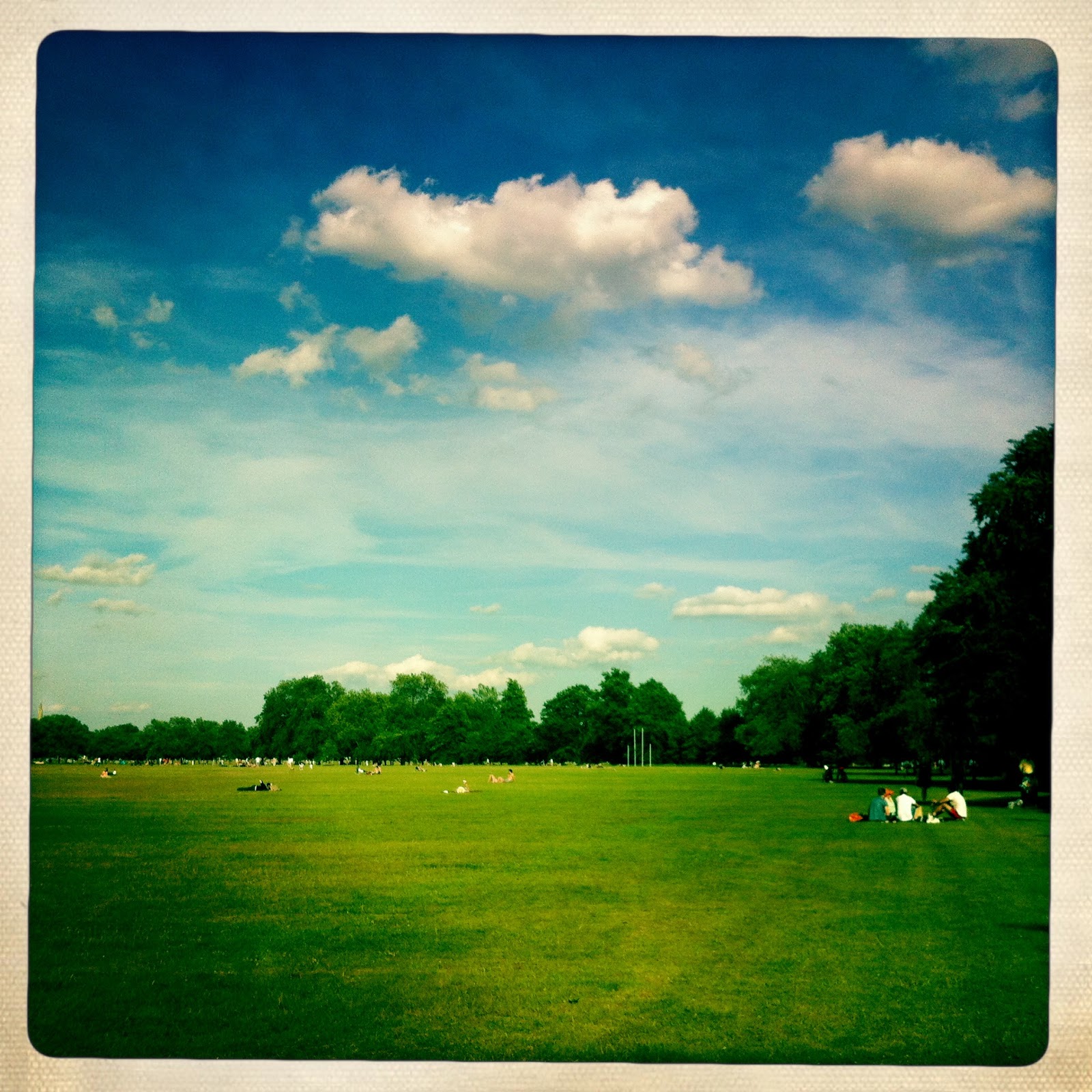
This is Clapham Common late on Sunday afternoon - flaming June finally arrived, if at the last minute.
In beween the two moments was Pride weekend, and I'll cover my Pride activities in forthcoming posts.
Tuesday, June 18, 2013
#guardiancoffee
The most Guardian headline of all time has recently been awarded to:
Can vegans stomach the unpalatable truth about quinoa?
I suspect the Guardian’s #guardiancoffee wheeze is going to generate some close competition.
The hashtag has already been amusing the twittershere for days. Huffpost claimed punters could meet Edward Snowden there for a latte; wags wondered if #guardiancoffee had anything to do with British intelligence’s faux internet cafes to spy on foreign diplomats.
Alex Hern of the New Statesman is insightful:
“If there was one thing the #guardiancoffee hashtag revealed, it’s that the Guardian starting a coffee shop in a container-based pop-up mall in Shoreditch is entirely unsurprising. It’s pretty much the perfect brand extension for them, reinforcing their image in the eyes of their target audience, middle-class metropolitan liberals, while only really damaging it for people who weren’t too hot on their politics anyway. … A coffee shop in Shoreditch is small fry. The Guardian is not. Clearly, there are reasons beyond simple revenue maximisation at play here.”
I think the idea is rather endearing, and hope it will work for them. Alex posits the location and environment will be good for techie types to meet in; the space could also operate as a quick ’n easy studio. It also serves as a space to meet the Guardian’s journalists for a coffee and a chat.
It seems the Guardian believes the future lies in the past - what they are doing, no less, is to reinvent the politically and socially activist 18th-century London coffee house for the 21st century.
I had no idea about all of this when I saw the invitation to apply to come for a morning coffee with Polly Toynbee. I’ve never won anything in a newspaper competition, but this time I did and an email from Guardian towers arrived with instructions to bring it to gain entrance.
The Shoreditch Boxpark concept is great - basically, a pile of reconditioned shipping containers are let out on a short-term basis to pop-ups, so there’s always something interesting and new going on there. The park is sited on Shoreditch High Street around the corner from the overground station and across the road from Shoreditch House. #guardiancoffee fronts on to the street, with massive Guardian branding on its glazing. It’s impossible to miss.
Inside, cut-through openings link the three adjacent containers which comprise the cafe. Inside is pretty cosy, with simple, wholesome wooden furnishings, techie-cool graphics wallpaper, and big screens wiring you up to the world on the walls (and iPads on the tables). A sort-of deconstructed cross between a Starbucks and an Apple shop.
The wall screen shows which coffees are most popular - the flat white had it by a mile, followed by the latte. I missed the reading for soy-based coffees.
There looks to be a good selection of cakes - as I was on the ‘2’ part of my 5-2 diet today I’ll have to sample them on another occasion. My invite swiftly, efficiently and politely dealt with at the door, it was a bit harder to get a coffee. Service seems to be provided by earnest young media intern types, not your usual Starbucks/Nero baristas, and I felt they were just getting into the swing of things. I eventually got one though, and took my seat in the throng around Polly. As one would expect, the Guardian is aiming at the artisan, quality end of the market. While good, the coffee is more expensive than Starbucks and comes in smaller cups.

The completely charming space doesn’t work that well for meetings of this sort - there were only thirty of us invited and some in the third container down struggled to catch comments made by those of us up at the front near Polly (and vice versa). However, the discussion did get going and developed a good flow - this concept could definitely work.
I was a bit nervous of trolls turning up but the group turned out to be very core Guardian-reader. They did a quick hands-up poll and interestingly the vast majority us were digital readers, and only a small minority CiF commenters. Polly asked who of us were political party members and a fair few were (I imagine not Tory).
So, amongst us lefty coffee drinkers the views were impassioned yet frustrated. There was definitely a feeling the left’s message wasn’t breaking through, and that in fact the left doesn’t appear to have a message at all. Poor Ed Milliband seems to bewilder and disappoint his natural supporters at the moment, and even Iraq made an appearance - all I can say is Ed apologised for the war at the best and earliest possible opportunity, but it is still unfortunately an albatross for the Labour Party several years later. Amidst all this angst Polly was a voice of calm and reason. Obviously, as a journalist with privileged insight into the daily mechanics of politics she is aware of how parties have to work hard to position themselves and not to give their best ideas away too soon before an election. But she strongly believed in the value of individuals participating in whatever way possible: clearly, campaigns such as UK Uncut have succeeded in setting the political agenda with even David Cameron now seeing the necessity to appear to do something about tax avoidance. Individual participation in group actions; independent discussions amongst friends, family and colleagues, all permeates out and moves the argument forward.
Subscribe to:
Posts (Atom)

