Sunday, November 01, 2015

Quote London

      
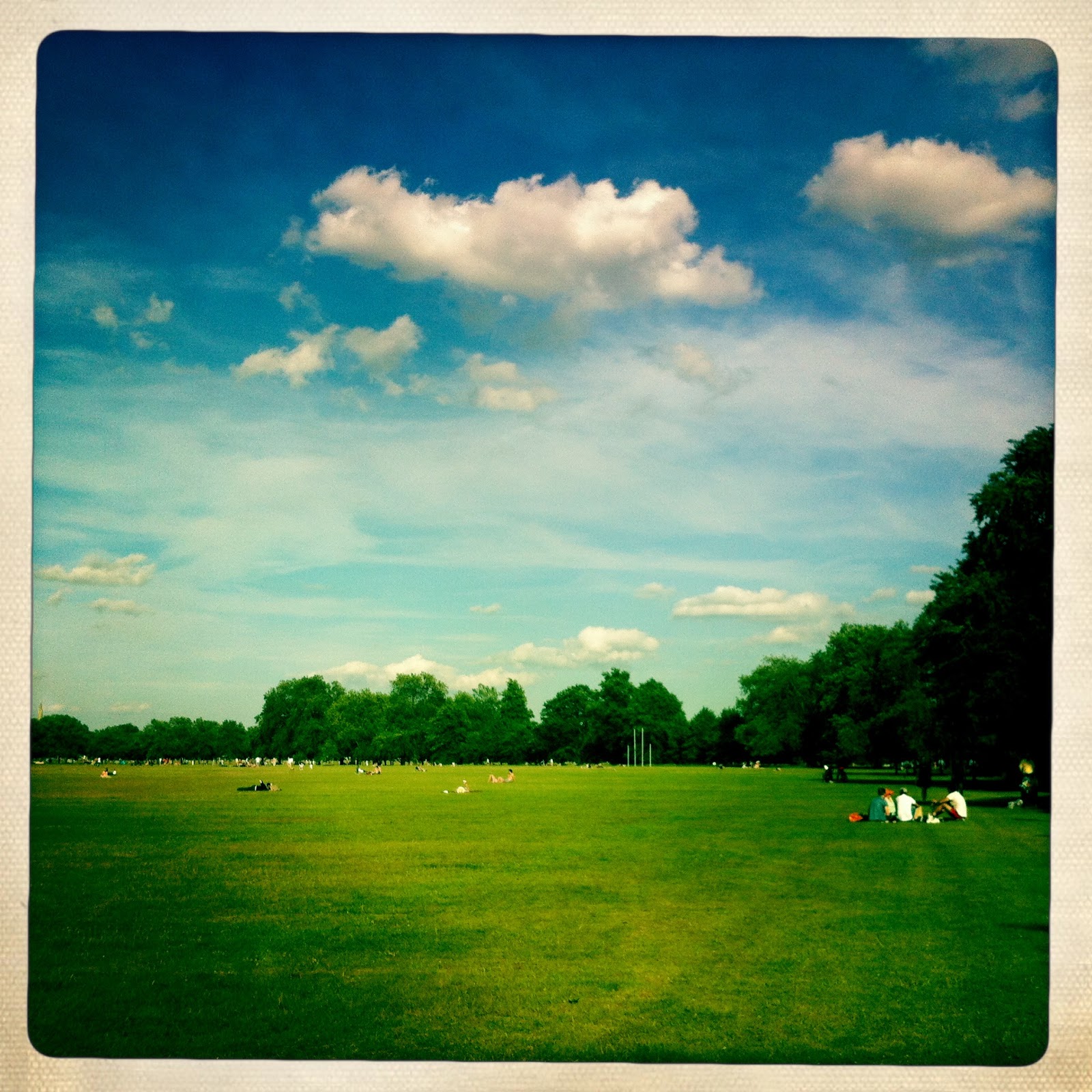
“A sprawling North London parkland, composed of oaks, willows and chestnuts, yews and sycamores, the beech and the birch; that encompasses the city’s highest point and spreads far beyond it; that is so well planted it feels unplanned; that is not the country but is no more a garden than Yellowstone; that has a shade of green for every possible felicitation of light; that paints itself in russets and ambers in autumn, canary-yellow in the splashy spring; with tickling bush grass to hide teenage lovers and joint smokers, broad oaks for brave men to kiss against, mown meadows for summer ball games, hills for kites, ponds for hippies, an icy lido for old men with strong constitutions, mean llamas for mean children and, for the tourists, a country house, its façade painted white enough for any Hollywood close-up, complete with a tea room, although anything you buy there should be eaten outside with the grass beneath your toes, sitting under the magnolia tree, letting the white blossoms, blush-pink at their tips, fall all around you. Hampstead Heath! Glory of London! Where Keats walked and Jarman fucked, where Orwell exercised his weakened lungs and Constable never failed to find something holy.”
- Zadie Smith, On Beauty

Thursday, April 23, 2015

Vicky Pryce and Polly Toynbee in Omnibus Clapham

The economist Vicky Price and Guardian columnist Polly Toynbee are or were both long-term residents of Clapham, and appeared together last night at Omnibus to discuss their new books: It’s the Economy Stupid by Vicky Pryce, Peter Unwin and Andy Ross and Cameron’s Coup by Polly Toynbee and David Walker. The event was co-hosted by Clapham Books - it’s great to see collaboration of this sort between our local independent bookshop and Omnibus.

Polly started the evening by praising the successful launch of Omnibus in the old Clapham library, and indeed it is great to see this handsome old Victorian public building finding a new public role in the local community. It certainly adds greatly to the mix of amenities around the new Old Town piazza area.

Both speakers were critical of the Coalition government. Polly spoke of the rigidity and stealthy determination of its ideological purposes; Vicky more of the evidence-free economic policy. Although a liberal herself, she was a government economist under both New Labour and Coalition administrations, and had words of praise for New Labour at least attempting to follow the evidence. Far from having “a long herm economic plan”, the coalition choked off reviving growth and flatlined the economy for its first two years, before surreptitiously u-turning and quietly and half-heartedly loosening fiscal policy. Basically, the Tories are ideologically incapable of accepting that government investment can create growth in the wider economy.

Polly seemed more wholeheartedly to support Labour, but I liked the way she always backed up claims with independent  evidence and sources. She strongly feels this is a very important election, and people should vote tactically to keep the tories out.

It was a very interesting evening, and very well attended: practically a full house.

Saturday, January 31, 2015

Quote London - Stockwell Watchmen

It seems north Londoners have always felt a little bit nervous of security arrangements south of the river - I was mildly amused to come across this diary entry by Joshua Wingate Weeks for 30 January 1779:
"When the service was finished I took a walk on the other side of the river into the country as far as Stockwell which is a small village about 4 miles from London ... Vauxhall Gardens are also here, which we passed by. We dined at Stockwell & returned home by another road. It was late in the evening & the lamps which extended from London  to this place were lighted & formed a most august and beautiful appearance. At small distances watchmen armed with musquets are placed to prevent mischief & detect robberies & they have bells placed in such a manner as to give notice to each other by ringing them if any thing remarkable occurs, by which means they could readily come to each others assistance & be upon their guard to prevent the escape of any suspected person."

The security state has had a long history!

(Quote from A London Year: 365 Days of City Life in Diaries, Journals and Letters, compiled by Travis Elborough & Nick Rennison. Published by Frances Lincoln, 2013)

Thursday, November 06, 2014

Fireworks over Brixton - Brockwell Park review


I really loved the way Lambeth always provided a free fireworks show for residents every year. Although obviously paid for out of our council taxes, it always felt generous and fun: a real community building experience the entire community could and did enjoy.

However times are tough and cash-strapped councils have to look to their bottom line in these days of endless austerity. So I feel very conflicted by Lambeth’s move this year to a ticketed event in Brockwell Park.

Brockwell is the only park in Lambeth with the potential to ‘hide’ a fireworks display from non-paying watchers - Clapham Common is completely open (The tories over in Wandsworth pioneered this approach in Battersea Park in the early 90s). Clapham Common has the best public transport access in the area as well. The Council claimed traffic was a problem with the Common’s event, which is why it moved to Brockwell originally. Brockwell’s poor public transport access however means a large proportion of the many thousands attending walk all the way from Brixton station on narrow pavements alongside busy roads in the dark.

As one approaches the park, many wardens were there to make repeated requests to ‘stay on the pavement’: but sheer weight of numbers make this completely impossible.

When I heard that the display was no longer free, I did consider boycotting it but in the end decided to go.

Sadly, the whole atmosphere of the event has changed.

Although Lambeth planned for around 50,000 attendees (around half of last year’s 100,000), people were crammed into a relatively small fenced-off area, which meant standing shoulder-to-shoulder in pretty packed conditions - not great for the many parents of small children there. Inadequate signposting in the dark meant getting into and out of the event was quite difficult and indeed frightening for some parents with toddlers. To me it felt like all the security was in aid of excluding non-payers and not on the safety of those attending.

Surprisingly for a commercial event (and in stark contrast to the free events of the past), the show was beset with organisational problems. The display started 30 minutes late, with no indication of why this was so, apart from blaming some people who had strayed into the fireworks fallout zone. Why this happened is unclear - never happened before to my knowledge. Were the security staff too busy checking tickets to keep an eye on the crowd?

When the show began, it unfortunately began with a poorly conceived “human catherine wheel” which must have been entirely invisible to 90%+  of the attendees. There were many disappointed and sarcastic comments around where I was standing - about a third of the way back and directly in line with the wheel. I am 5’11”, there were no trees in the way, and I couldn’t see a thing. People in front were holding up mobile phones - I could see on the screens the phone cams weren’t picking anything up either! Only in the dying moments of the act did we see a dim glow in the distance. Note to organisers: this sort of curtain-raising event needs to be elevated so the crowd can actually see it. A pre-warm-up event - the excellent electricity boys - were slightly elevated and this made all the difference.

The fireworks proper started immediately afterwards and as usual, were magnificent. Excellent choreography and pacing, with terrific variety of types and stupendous climaxes. I also enjoyed the soundtrack and felt the sound system was better than usual: however, as mentioned above I was nearish to the front and I gather those behind found the fairground music clashed with the fireworks soundtrack. I couldn’t hear the fairground at all.

And then a crush in the dark to get out. Following others blindly in the hope they knew where to go (in the absence of any direction from the organisers). Mud everywhere. 

We’ll see what I feel like next year. Although I am sure the fireworks will be as spectacular as always and well worth the £7 charge, I’m not sure I am prepared to put up with all the hassle of actually attending the event.


Monday, November 03, 2014

Quote London

"I arrived in 1978 from China, where the parks had been ransacked and cultivating flowers was condemned as a bourgeois habit. When I saw chestnut trees and expanses of lawn in London, I was almost mad with joy. These days I like to take a stroll in HYde Park, and I always end it by reading a book at the Orangery." - Jung Chang

Monday, August 04, 2014

100 Years

While watching the Westminster Abbey service tonight I got the urge to light a candle. Both my grandfathers fought in WW1, on opposing sides. My English grandfather ran away from home and lied about his age to get into the Royal Flying Corps (the forerunner of the RAF). He survived the war and remained in the RAF for the rest of his career, retiring in the 1950s. My Polish grandfather regarded himself as Prussian and fought in the German army. He survived a gas attack, but his lungs were severely compromised. He was a farmer by vocation and ended up on a glorious smallholding in the hills above Durban, South Africa. He sent me boxes of his home-grown passion fruit when I was a child. Both grandfathers died in the 1970s.

And that was the sum total of our family's history with WWI, or so I thought. Recently my brother and I have been tracing our family tree, and I was pretty surprised to find I had a grand-uncle Percival living at home in the schoolhouse at Slapton Sands, Devon, in the census of 1911 (My great-grandparents were the school teachers there). He was a tailor's apprentice. He was born in 1894, so was peak age for cannon fodder in the war. He died somewhere in 1916. I still have to follow up all the details.

The odd thing is no one in my family ever mentioned him. My grandfather never said a word. I don't think my father or his sister Patricia even knew of Percy's existence - my aunt Patricia had a huge fund of family stories and was interested in all the connections so I feel certain she would have said something about him if she had known.

Poor Percy. In memory of his short life and miserable death, a candle tonight.


Thursday, July 10, 2014

Sunset over the Thames

Midsummer evening, London. From Hungerford Bridge

Friday, January 31, 2014

BBC Horizon: Fat vs Sugar

This BBC2 documentary on the Fat/Sugar debate was dismally poor science, if entertaining TV.

Doctors Chris and Xand van Tulleken, who are identical twins, go on month-long diets comprising high volumes of fat or sugar to find out which is worse for the human body.

The two good doctors are exceptionally telegenic, and of course are medical professionals, but don’t appear to be driving the science behind this show - instead they are merely pretty faces and guinea pigs. I would like to know who was the scientific brains behind the show. Some of the experiments - like the low blood sugar bike race up Box Hill - just show something banal, and which the sugar industry has been promoting since at least the 50s - “Sugar gives you energy”. Not a whisper about high / low GI, or the fact that refined sugars are empty nutritionally.

To be fair, neither diet appears to have been a fair reflection of current recommendations from nutritionists in either camp. Going to extremes is good for dramatic effect, but little else. The adverse effects of too little “sugar” are interesting, but I can’t think of anyone who would advocate eliminating carbs in this way - even the dreaded Dr Atkins. The diet tested for ‘zero carbs’ rather than for ‘zero added processed refined sugars’ and therefore missed testing the specific diet the zero-sugar camp is particularly focussed on. An interview with the high-priest of zero sugar, Robert Lustig, was about 10 seconds long and mainly jokingly asked if he’d like a bucket of doughnuts.

While the conclusions seemed reasonable - moderation in all things - I think the programme let refined sugars off the hook. Beeb, we still await a serious investigation of the claims of the no-sugar camp.

Monday, January 13, 2014

Pearls

It’s the time of year when you realise with a start that all the major exhibitions you’ve been meaning to see all winter are about to close. Pearls at the V&A ends on the 19th.

It wasn’t a particular “must see” of mine, but a friend wanted to catch it and I tagged along for the ride.

Reader, if you have been meaning to see it but haven’t got around to it, I would avoid the last weekend absolutely. There will be an incident.

Lesley remarked that the V&A seemed to have spent more time considering customer flow patterns in the shop than in the exhibition. It really is the most cramped exhibition I have ever attended in London, and that is quite a competitive field.

Museum exhibition designers just don’t appear to think about crowded conditions. The experience is just so miserable.

Here we have a quite frankly awesome collection of gems from all over the world - featuring some unique and historically very important examples. They are all, obviously, tiny and need close observation.

So let’s put them in a dark room. Why the dark? Does electric light fade pearls? - and then place screeds of text in small fonts at the bottom of each display case. Viewers will then cluster round the display case blocking the view of others behind them. Meanwhile, those others are casting shadows across the text panels, making them hard to read and making sure that the people in front spend even longer in front trying to work out what number 6, 7, 8, 24 is and what it all means. Cleverly, I had picked up one of the large-print exhibition guides (with all the exhibition texts) on offer at the entrance - it helped a bit, but it still was so dark that reading even this had difficult moments.

There was no room to move about on your own volition - visitors are funnelled though from start to finish. Think Ikea, but in the dark and in rush-hour tube conditions. I started to panic halfway through.

One feels that fewer exhibits given more space to breathe might have helped - but it would have been a pity to miss some of the really wonderful examples the curators had assembled. The V&A really need to have given this whole show more space.

This issue does seem to recur in recent V&A offerings. I recall desperately cramped sections of the Hollywood costumes show. Very clever, varied design helped the David Bowie show a lot (also, I went to this multiple times so could skip bits that were too crowded, catching them on a second or third visit as necessary. I’m a Friend and can do this - my sympathies to those to have to shell out quite a lot nowadays for a single ticket).

Rant over.

The show is beautifully curated and the organisers seem to have gone out of their way to be super-educational on all aspects of the pearl industry. I noticed this trend at the Museum of London’s Cheapside Hoard exhibition as well - almost as if there is some guilt involved here; the educational content makes up for all the luxuriating in the frivolous trinkets of the super rich. Actually, comparisons with the Cheapside Hoard show are apt here because their display was far better organised than the V&A’s Pearls. But I reckon security is the big unspoken issue - the Museum of London has turned its entire exhibition room into a strongbox; here at the V&A each display case was its own safe - no doubt locked up every evening for protection.

Two things I learned about pearls:

1) No pearl is created by a grain of sand irritating an oyster. Instead, pearls seem to be a response by the animal to parasitic invaders - usually tapeworms. The oyster captures the invader in a cyst which continues to grow until it becomes a pearl.

2) Every shellfish can make pearls - but most usually and frequently bivalves. And not just oysters - the humble mussel can too.

I was quite staggered I hadn’t known about the parasitical origin of pearls before. But I suppose it’s not in the interests of the industry to promote that knowledge - not something their customers would enjoy knowing, wearing a pearl necklace!


Thursday, December 12, 2013

Au Bon Accueil

One of my first trips to Paris was with friends, in the winter. I remember we made our way to the Trocadèro and walked down to the Eiffel Tower and up the Champ de Mars to Les Invalides. It was beyond freezing, with a vicious wind and grim lowering leaden clouds. However, we were young and foolish and high on an exciting journey to the most glamorous city in Europe.

Yesterday, I retraced that walk with my friend Nicolas. We were in Paris to catch the Masculin / Masculin exhibition at the Musée d’Orsay and Nic had arranged for us to eat lunch at a friend’s restaurant near the Eiffel Tower. We got off the Metro at the Trocadèro to be welcomed by a sublimely beautiful winter’s day.
You just don’t get light like that in London - crisp and high-keyed and blindingly clear. The Trocadèro’s polished marble platform bounced it all around amazingly - heaven for two amateur photographers. In the distance, the tower shimmered like a mirage in the miraculously blue sky.
After walking down across the Seine to the tower we explored the bottom section of the Champs de Mars a bit before heading off to the restaurant: Au Bon Accueil - ‘The good reception’. And what a reception it is.
I was excited as although I’ve been a fairly frequent visitor to Paris I’ve never eaten at a smart contemporary restaurant at the top of its game. Au Bon Accueil has a deliciously lacquered maroon frontage onto the street, and is a calm refuge within - simple and luxurious textures of stone and wood enclose intimate spaces. One of the stone columns had been carved by a grateful customer - a Bacchus or vaguely Assyrian monarch surveys the room. Front of house staff were friendly and efficient - you just immediately feel in very good capable hands. We quaffed a delicious glass of champagne and consulted the menu.

It seems I have good luck with fish in Paris. On that earlier trip a waiter at La Coupole (of course) suggested a fish dish different to my initially ordered salmon. As it was cheaper I went with his suggestion but if my French was up to the menu I might have avoided it: I seem to remember it was mullet with red wine and bone marrow (??!) However, it came, and was totally wonderful. On my last trip - a work outing with colleagues - I was desperate to eat at the hottest, smartest place in town and spent the day trawling my trade fair consulting restaurant guides and barking instructions to Angela (who spoke French), to try to get a table. Sadly, everywhere was booked and when we got back to the hotel that evening the colleagues were too exhausted to go out, and suggested we eat at a place next door. This turned out, hilariously, to be a celebrity hang-out from the 1950s totally fossilised in its time. Our table was treated with disdain until we ordered a second bottle of wine. Jo didn’t want a starter and I fancied two on the menu, so ordered tuna tartare for her for me to eat. It came and it turned into a tuna stand-off, it was so delicious.

But my salmon starter at Au Bon Accueil trumped all: a generous slab of salmon fillet, briefly seared (basically, sashimi). Breathtakingly gorgeous - a real work of art, with delicate dabs of different sauces, condiments and vegetables arranged as if by a florist or a jeweller on the plate. Lovely textures and flavours, really leaving me wanting more: a perfect starter.
The arrival of our poached and roasted chicken breast main course was heralded on our table by a culinary implement I have not seen before: a “pelle à sauce” (sauce shovel). This is something I can get behind! Especially when the sauce in question was the unctuously smoky mashed potato accompanying the chicken.

Again, achingly beautiful composition was backed with flawless execution: the chicken was tender, flavourful and juicy, with skin crisped to perfection by the roasting. A drift of blanched brussels sprouts leaves across a smear of sweet potato added a touch of wit and colour to the plate.
For pudding I fancied the brioche perdu, which Nicolas informed me was French comfort food (he went for the chocolate tart). My brioche was lovely, a squidgy yet fluffy square of caramelised eggy goodness, punctuated by the sharpness of mango and passion fruit. It came with a separate jug of caramel-topped whipped cream. So perfect.
We ordered from the lunch menu and both thought it offered excellent value for the price. Although we both felt that nowadays one can find similar quality food in London, it typically comes at three times the cost. Also, in my experience the lunch menus in London tend not to be as generous or imaginative.
After this wonderful meal we said our goodbyes and hurried off to the Musée d’Orsay for Masculine / Masculine. All I can say is the quality of the reception at Au Bon Accueil is mirrored superbly by the quality of the food. I’d love to go back.


Wednesday, July 17, 2013

Tweet of the day


Monday, July 01, 2013

Weekend

A weekend in London on the hinge of the year - bookended by two photographs -


Taken from the balcony of a stunning 17th-floor apartment in north London on friday evening. Night was falling but the looming clouds are deceptive - they were clearing rather than gathering:


This is Clapham Common late on Sunday afternoon - flaming June finally arrived, if at the last minute.

In beween the two moments was Pride weekend, and I'll cover my Pride activities in forthcoming posts.

Tuesday, June 18, 2013

#guardiancoffee

The most Guardian headline of all time has recently been awarded to:

Can vegans stomach the unpalatable truth about quinoa?

I suspect the Guardian’s #guardiancoffee wheeze is going to generate some close competition.

The hashtag has already been amusing the twittershere for days. Huffpost claimed punters could meet Edward Snowden there for a latte; wags wondered if #guardiancoffee had anything to do with British intelligence’s faux internet cafes to spy on foreign diplomats.

Alex Hern of the New Statesman is insightful:

“If there was one thing the #guardiancoffee hashtag revealed, it’s that the Guardian starting a coffee shop in a container-based pop-up mall in Shoreditch is entirely unsurprising. It’s pretty much the perfect brand extension for them, reinforcing their image in the eyes of their target audience, middle-class metropolitan liberals, while only really damaging it for people who weren’t too hot on their politics anyway. … A coffee shop in Shoreditch is small fry. The Guardian is not. Clearly, there are reasons beyond simple revenue maximisation at play here.”

I think the idea is rather endearing, and hope it will work for them. Alex posits the location and environment will be good for techie types to meet in; the space could also operate as a quick ’n easy studio. It also serves as a space to meet the Guardian’s journalists for a coffee and a chat.

It seems the Guardian believes the future lies in the past - what they are doing, no less, is to reinvent the politically and socially activist 18th-century London coffee house for the 21st century.

I had no idea about all of this when I saw the invitation to apply to come for a morning coffee with Polly Toynbee. I’ve never won anything in a newspaper competition, but this time I did and an email from Guardian towers arrived with instructions to bring it to gain entrance.

The Shoreditch Boxpark concept is great - basically, a pile of reconditioned shipping containers are let out on a short-term basis to pop-ups, so there’s always something interesting and new going on there. The park is sited on Shoreditch High Street around the corner from the overground station and across the road from Shoreditch House. #guardiancoffee fronts on to the street, with massive Guardian branding on its glazing. It’s impossible to miss.

Inside, cut-through openings link the three adjacent containers which comprise the cafe. Inside is pretty cosy, with simple, wholesome wooden furnishings, techie-cool graphics wallpaper, and big screens wiring you up to the world on the walls (and iPads on the tables). A sort-of deconstructed cross between a Starbucks and an Apple shop.

The wall screen shows which coffees are most popular - the flat white had it by a mile, followed by the latte. I missed the reading for soy-based coffees.

There looks to be a good selection of cakes - as I was on the ‘2’ part of my 5-2 diet today I’ll have to sample them on another occasion. My invite swiftly, efficiently and politely dealt with at the door, it was a bit harder to get a coffee. Service seems to be provided by earnest young media intern types, not your usual Starbucks/Nero baristas, and I felt they were just getting into the swing of things. I eventually got one though, and took my seat in the throng around Polly. As one would expect, the Guardian is aiming at the artisan, quality end of the market. While good, the coffee is more expensive than Starbucks and comes in smaller cups.


The completely charming space doesn’t work that well for meetings of this sort - there were only thirty of us invited and some in the third container down struggled to catch comments made by those of us up at the front near Polly (and vice versa). However, the discussion did get going and developed a good flow - this concept could definitely work.

I was a bit nervous of trolls turning up but the group turned out to be very core Guardian-reader. They did a quick hands-up poll and interestingly the vast majority us were digital readers, and only a small minority CiF commenters. Polly asked who of us were political party members and a fair few were (I imagine not Tory).

So, amongst us lefty coffee drinkers the views were impassioned yet frustrated. There was definitely a feeling the left’s message wasn’t breaking through, and that in fact the left doesn’t appear to have a message at all. Poor Ed Milliband seems to bewilder and disappoint his natural supporters at the moment, and even Iraq made an appearance - all I can say is Ed apologised for the war at the best and earliest possible opportunity, but it is still unfortunately an albatross for the Labour Party several years later. Amidst all this angst Polly was a voice of calm and reason. Obviously, as a journalist with privileged insight into the daily mechanics of politics she is aware of how parties have to work hard to position themselves and not to give their best ideas away too soon before an election. But she strongly believed in the value of individuals participating in whatever way possible: clearly, campaigns such as UK Uncut have succeeded in setting the political agenda with even David Cameron now seeing the necessity to appear to do something about tax avoidance. Individual participation in group actions; independent discussions amongst friends, family and colleagues, all permeates out and moves the argument forward.

Sunday, May 19, 2013

Eurovision 2013 - The Finals


Congratulations Denmark! Emmelie de Forest is the 2013 Eurovision Song Contest winner with her song "Only Teardrops". It was a relatively closely-fought contest this year, with Azerbaijan coming second.

I’m now officially a Eurovision obsessive. Two friends took me out to dinner in Shoreditch last night in an effort to stem the tide of tweets, all to no avail: all three of us ended up late in the evening on our phones following the fun on twitter, and went back to Paul’s flat afterwards to watch the voting.

My London overground train homewards stranded me at Surrey Keys, and I had to catch two night [Clapham] omnibuses meandering lazily across south London to get back to home base, arriving around 2:30am. I immediately hit iPlayer to catch up on the bits I’d missed.

Of course I was disappointed my favourite Norway didn’t win. I thought Margaret Berger’s final-night nerves showed a little, and sadly “I Feed You My Love” proved to be slightly in advance of current Euro taste, but nevertheless still came a creditable fourth.

Bonnie Tyler gave a heart-warming, engaging performance for the UK but her voice was fragile (too many pre-event interviews?) and the song “Believe in Me” sadly not good enough to do well, although we bettered last year’s dismal second-from-last.


Sweden was never going to win twice running, and Spain’s wasn’t a strong song. I tend to admire France's always sophisticated entries, and Amandine Bourgeois's "L'enfer Et Moi" was no exception - sadly Europe disagreed. Cascada gave a good performance for Germany, but their song “Glorious”  frankly shouldn't have been allowed - it was a virtual aural photocopy of Sweden’s “Euphoria’, even if  officially cleared of plagiarism allegations. A pretty shameful entry from Germany.

Of the big six, Italy did the best (and far better than I anticipated) with a seventh place for Marco Mengoni,  gigolo sharp in a super stylish suit with a massive deconstructed quiff.


But what can one say of the catastrophic results for Finland and Ireland?


Finland’s entry, although cutely and unapologetically bubbly Euro-pop (Krista Siegfrids: “Marry Me”), was nevertheless overtly and politically gay, ending in a lesbian brides’ kiss. Ireland played it straight (Ryan Dolan: “Only Love Survives”) but with backing drummers and dancers who came right out of a gay club night, all oiled muscular torsos and tattoos. Both songs were much much better, with much better performances, than many others that ended far higher up the leader board. Both Finland and Ireland usually do far better in the competition too. So why? Too Queer for Europe?


If so, how ironic for the premier European gay event. Petra Mede, the brilliant Swedish hostess for the night, made knowing, ironic remarks to the ‘Dancing Queens” in the audience who “just haven’t met the right girl yet” - and Sweden’s interval act matched the Finnish Lesbian wedding with a gay male one. As Graham Norton noted, that will give the Azerbaijanis and Georgians something to scratch their heads over.

All-in-all, a triumph for Sweden - terrifically staged. Next year, over the Øresund Bridge to Denmark.

[All photos courtesy EUROVISION]

Saturday, May 18, 2013

Eurovision 2013 - 2nd Semifinal


We have a winner!

I think Norway effortlessly outclasses everything in this competition and should win by a mile. Margaret Berger is an epic Nordic electro ice queen with an anthem that just blows you away. Her song - "I Feed You My Love" - was wonderfully staged and choreographed - minimal, stylish, classy. Gorgeous art deco / Metropolis references. I have a sense that Eastern European audiences are aesthetically in advance of the authorities who choose their countries' entries - so hopefully this very contemporary arrangement will chime with the voters and carry the wonderful Ms Berger to the winner's enclosure.


Norway was also rocking those 2013 essentials, drums on stage - but again, in a masterfully understated way. Drums were very evident once again in Semis 2, but another trend also emerged: geeks are in. Several countries, notably Malta and Hungary, featured geeky boys - here is Hungary's ByeAlex with his entry "Kedvesem":


Finland caused a mini storm in a euro teacup with the lesbian kiss at the end of their cute song. Well done Krista Siegrids and the team behind "Marry Me":


Finland was actually the tamest of the off-beat entries - there were a few classics, not least Romania's Cezar with "It's My Life":


wardobe


Overall, I was pleased Norway and Finland got through, but sad Israel and Macedonia didn't. But that's the semi's done and it's now full speed for the grand final on Saturday night.


Wednesday, May 15, 2013

Eurovision begins! - 2013 Semifinals 1

Malmö is a gorgeous city, and must be basking in the honour of hosting Eurovision 2013, which kicked off last night with the first semi-finals. Twitter, as usual, erupted.


The above tweets were in response to this classic Eurovision effort from Serbia:
However, even this was surpassed by the frankly bonkers entry from Montenegro, a must see foregrounding rapping Montenegrin astronauts:
A final costume shout-out must go to Moldova, whose highly imaginative designers dressed their singer in a stunning volcano dress:


In terms of trends, male performers seem to be out of favour this year. Violins on stage have completely vanished. Denmark was rocking the Scandinavian waif look, which has cropped up a few times in the recent past from the Baltics - have to say, though, Denmark has totally nailed it this year. This is my favourite. Big congratulations to Emmelie de Forest with her song "Only Teardrops":


 Denmark also introduces a key new trend this year: drums on stage are the new violins. Another notable exponent was Ireland, interpreting the theme perhaps a little too enthusiastically:


 Lead singer pickled in fake tan and tooth bleach, back up crew in tight black leather, dancing topless tattooed drummers, and a storming dance anthem - is Ireland trying to become Greece? Overall, Ryan Dolan and his song "Only Love Survives" met with a favourable response - another possible contender.
Sadly I will be missing the Eurovision finals this year. However, I will watch tomorrow's semi-final with great interest.

Tuesday, April 16, 2013

Margaret Thatcher 1925-2013

"Where there is discord may we bring harmony. Where there is error, may we bring truth. Where there is doubt, may we bring faith. And where there is despair, may we bring hope." - Margaret Thatcher, on first entering 10 Downing Street as Prime Minister (paraphrasing the prayer of St Francis)
“To me, consensus seems to be the process of abandoning all beliefs, principles, values and policies. So it is something in which no one believes and to which no one objects.” - Margaret Thatcher
“Yes I do believe in consensus, there should be a consensus behind my convictions.” - Margaret Thatcher
Today her nation buries Margaret Thatcher, and I hope no one gets hurt or does anything stupid. Britain has in the past been adept at buying its departed politicians quietly, decently and without partisan rancour. Ceremonial is strictly for the Royals and national heroes like Winston, Horatio and Wellington. Not this time, unfortunately.

Margaret Thatcher is undoubtedly one of the greats - the first woman Prime Minister of Great Britain, and an ideological warrior and a game-changer. She’s been out of office for almost a quarter of a century, and retired from public view for almost a decade, but still the -ism that bears her name rules this country, with all three main political parties signed up to its basic tenets (and the insurgent party, UKIP, loudly proclaiming itself to be her true heir).

She revelled in partisanship while in office and lived for arguing her point of view. Ultimately her own cabinet, exhausted and terrified of where she was leading them, threw her out. Her opponents never got the chance to vote her out, and the treacherous Tories subsequently tore themselves apart in guilt and revenge.

Hence the ugly atmosphere and our heavy collective mood. Our Tory Prime Minister, who ironically was bequeathed these bombastic funeral plans by his New Labour predecessors, has equally ironically achieved no poll bounce off the back of a full week’s media Thatcher fest. Both right and left wing editorialists have decried the grandeur of the funeral, and it seems all those Thatcher TV shows actually achieved poor ratings. Some left wingers have shocked the world with their “Thatcher Death parties” and campaigns to get “Ding Dong the Witch is Dead” into the pop charts; equally, elements on the right wing have invited scorn by whinging Obama isn’t showing enough respect and drooling over the decidedly dicey D-list ragtag assortment of celebs, ex-cons and has-beens invited. The Tory chairman Grant Schapps wrote a letter out to all the constituency faithful to come and line the route this morning: are they frightened that no-one in London apart from the protesters will actually be brave enough to face the hyped-up police and security?

I’ve been immersed in it all, trying to make some kind of sense of what Maggie means to me. I don’t think we are quite there yet. She was a massive force, and did some things very right and some things very wrong. Her legacy is still unwinding and we are in its wake - it may take another thirty years before we can start to sum up. I think she is a transformative figure, up there with William the Conqueror, Henry VIII, and Oliver Cromwell. Massive winners and massive losers, always destined to be radically reinterpreted for every generation.

But I do think that her political analysis of the 70s wasn’t that remarkable - in fact, it was pretty close to being the consensus view. It is clear successive moderate Conservative and Labour governments could see exactly what they needed to do (and some of Thatcher’s most eye-catching policy innovations were in fact first thought of by Labour). They all failed, lost their nerve. And government failure is important, in that it doesn’t return things to where they were before - it moves them on: in this case driving extremism on both left and right. And Thatcher herself was the insurgent candidate from the far right of her party, and the era’s political genius to boot. So she won, and got to apply the ‘cure’ (a readjustment of the economy both parties knew had to be made) her way, through extreme radical ideological methods, tearing apart the country in the process and leaving us where we are today.

Monday, March 11, 2013

A London Weekend

However long you live here, London always throws up something new, surprising and fabulous. It’s diversity doesn’t stop at having the largest number of foreign communities resident - every Londoner’s specific interests are catered to in depth as well, allowing for wonderful crossovers, mashups and discoveries.


So this last weekend was a bit of a London mash-up for me. It started, as all good weekends do, on Friday evening. A friend treated me to a play at the National Theatre: This House by James Graham. This is not the sort of play I am usually interested in - contemporary, and about 70’s politics and House of Parliament procedures. My usual theatrical interests are Classics (deep!) and Stars (shallow!) - I recently took in James McAvoy’s Macbeth, covering both - so This House was completely off my radar until I saw a trailer for it at the cinema. It looked amazing! It turns out that it’s a National Theatre hit and had returned for a second run at the larger Olivier theatre.


We were lucky to get great seats in the auditorium. The staging has a block of parliamentary style benches on stage, and some lucky audience members get to sit on these - the blocks are on two of the Olivier’s revolves and swivel round for scenes set in the House for parliamentary votes. Most of the time they are flat on and the front of the stage becomes the Whips’ offices as they plot and scheme (Tories) or desperately try to keep things afloat (Labour).


The play covers events from the fall of Ted Heath to the rise of Margaret Thatcher, through the eyes of the Whips. The Tories are blasé, urbane, worldly, and have seen it all before. Born to rule. Witty, but prone to bullying their newbies and snobbish. They become increasingly nervous of the top dog as Thatcher entrenches her leadership (initially portrayed as a weird fluke they expected not to last).


The Labour side show mainly working class types and accents (and the only women MPs in the play). The men swear like sailor’s parrots and then apologise to the women, who get annoyed by the apologies. Wilson’s government had a wafer-thin margin and was expected to fall within weeks - however, it lasted 4.5 years, and the play shows the desperate lengths the Labour whips went to to keep it all together (and the lengths the Tories went to to take them down). It’s all very funny and engrossing but one is aware that Thatcher wins in the end and changes everything (the play ends with a recording of her famous victory speech in 1979).


We repaired afterwards for a debrief and cocktail at Skylon’s bar. I’ve not eaten in this restaurant in its current incarnation (I did before when it was run by a celebrity chef) - the room itself is so much more beautiful and glamorous now after the Royal Festival Hall refurb. It also benefits from the fifties revival trend. We quaffed fab cocktails, surrounded by Italians - so many of them around in London at the moment. Our discussions turned on the Parliamentary news of the moment - the spectacular and catastrophic fall from grace of Coalition minister Chris Huhne and his ex-wife Vicky Pryce, dubbed “the Clytemnestra of Clapham”. Indeed this is a greek tragedy, with both parties being sentenced to a jail term for perverting the course of justice today (over a speeding ticket in 2003!), but all their family dirty laundry has been fully aired in the press over the last few months. The Huhnes’ marital home was actually quite near to me, I’m familiar with their street in a “would love to live there’ kind of way. I also lived for many years with someone who went back and forth to Europe frequently, and would no doubt have known the stretch of road Huhne was caught speeding in (luckily, my housemate had a driver to ferry her to and from the airport so speeding was never an issue).


So far, so usual for me but Saturday would see me yanked right out of my usual tracks.


My niece is in a women’s eights team (Cantabridgian juniors) and was booked to race in the Womens’ Eights Head of the River Race (WEHORR) on Saturday. I’m vaguely aware of the Oxford/Cambridge boat race at the end of March but it appears that the whole of March is a big racing month on the Thames for rowers. My knowledge of rowing is not extensive (I called them ‘paddles’ and was put firmly right by a rowing mother - they are correctly called “blades”).

I met my brother and sister-in-law at the Battersea Affordable Art Fair where they had just made a purchase, and we taxi’d to the finish line at Putney Bridge just as the first boats arrived.


There were around 330 boats taking part. A ‘head’ race means they aren’t all actually starting at the same time - they are let go in batches in number order, so are racing against the clock. Coxes and teams use “Cox Boxes” to monitor their progress. The race goes downstream from Chiswick to Putney (the Oxford/Cambridge race goes upstream but timed to start on an incoming tide).


There was a great atmosphere amongst the crowds of supporters, and the sight of all the boats on the Thames was magnificent. we were treated to watching them sprint for the finish line in front of us and then double back past us to where they disembarked.


It took hours though for them all to come through, and the temperature noticeably dipped throughout the afternoon. After my niece’s team sailed past (they did well and were rightly proud of their achievement in their first big race, even with a broken cox box), we supporters all repaired to The Duke’s Head pub for a very late lunch.


The Duke’s Head is a quintessential rowers’ pub, and makes the most of its prime position on the start line of the Oxford/Cambridge boat race with a magnificent dining room - soaring ceiling and massive windows on three sides overlooking the river - and racing paraphernalia as decoration. The pub nails its colours firmly to the mast with its walls a Cantabridgian light blue.


Lunch/dinner was a hugely welcome wild boar burger with triple fried chips and a bowl of “allotment vegetables” - chanterey carrots, savoy cabbage and french beans. I toasted my niece’s team’s performance with a glass of sauvignon blanc, even as said team was whisked back to Cambridge thoroughly exhausted from their 4 hours on the icy river.

Thursday, February 28, 2013

Spring in Clapham

A brilliant display of crocuses out on the Common this February - last year the early Spring was so hot it killed them off early
Lambeth Council at work pruning the large Plane tree at the entrance to the Common

Very neat work!

Meanwhile, on The Pavement, Boulevard cafe life gets into swing despite Arctic temperatures
The council men cleaning up after themselves

Industrial wood chipper in action!


Tuesday, January 01, 2013

Happy New Year


Happy New Year!

Onwards and upwards: it's our annual chance to forget all the troubles of the past year, start anew and to dream big again. May it bring happiness to us all. It looks like it's going to bring the long-awaited Abba Museum to Stockholm, which is another reason to visit Sweden again (along with the Eurovision Song Contest in Malmö this May).

My new year was very mellow, as I didn't feel like venturing out of the warmth into rain-drenched London town to see the fireworks or do any parties. Instead I paid culinary tribute to my half-Polish origins by making a batch of placki kartoflane (pronounced PLAHTZ-kee kar-taw-FLAH-neh) and washing them down with Winter Pimms (this representing my English half). The pancakes were a huge treat when I was a child - I remember it was my dad's job to grate the onions; my mum would then mix the grated onion with grated potatoes, a tablespoon or so of flour, salt, pepper, and an egg or two and then fry the batter in a deepish slick of hot oil until the pancakes were crispy golden brown on the outside and meltingly soft inside. I think the grated vegetables allow more mixing with the fat and therefore possibly an even higher fat content than French Fries (the pancakes also take quite a lot of salt).


These days I drain them on kitchen paper before eating, and limit myself to one batch a year - usually in the winter when one needs a bit of mental and physical insulation.

I also pace myself - two medium-size baking potatoes' worth of placki go quite a long way, although they are very moreish. So the batter sits by a pan all evening - heating up the pan and frying a batch of three placki is the work of minutes (getting rid of the excess poundage from one's waistline will of course take months).

With friends and relatives spread out now across the globe, new year greetings, texts and calls started coming in at 2pm (Australia), followed by India, Zanzibar, South Africa, The Netherlands, and then finally Los Angeles. It was fun to feel the New Year wash over the globe like a gigantic wave. The world seems a lot smaller than when I was a child.


Now, of course, cities compete on YouTube for the best fireworks display - with Sydney and London being the most competitive. London's was extraordinary, if slightly spoilt by all those Tory voiceovers. New Year's fireworks as State propaganda. Oh well, at least it was over in 12 minutes!