Showing posts with label quote. Show all posts

Sunday, November 01, 2015

Quote London

      
“A sprawling North London parkland, composed of oaks, willows and chestnuts, yews and sycamores, the beech and the birch; that encompasses the city’s highest point and spreads far beyond it; that is so well planted it feels unplanned; that is not the country but is no more a garden than Yellowstone; that has a shade of green for every possible felicitation of light; that paints itself in russets and ambers in autumn, canary-yellow in the splashy spring; with tickling bush grass to hide teenage lovers and joint smokers, broad oaks for brave men to kiss against, mown meadows for summer ball games, hills for kites, ponds for hippies, an icy lido for old men with strong constitutions, mean llamas for mean children and, for the tourists, a country house, its façade painted white enough for any Hollywood close-up, complete with a tea room, although anything you buy there should be eaten outside with the grass beneath your toes, sitting under the magnolia tree, letting the white blossoms, blush-pink at their tips, fall all around you. Hampstead Heath! Glory of London! Where Keats walked and Jarman fucked, where Orwell exercised his weakened lungs and Constable never failed to find something holy.”
- Zadie Smith, On Beauty

Saturday, January 31, 2015

Quote London - Stockwell Watchmen

It seems north Londoners have always felt a little bit nervous of security arrangements south of the river - I was mildly amused to come across this diary entry by Joshua Wingate Weeks for 30 January 1779:
"When the service was finished I took a walk on the other side of the river into the country as far as Stockwell which is a small village about 4 miles from London ... Vauxhall Gardens are also here, which we passed by. We dined at Stockwell & returned home by another road. It was late in the evening & the lamps which extended from London  to this place were lighted & formed a most august and beautiful appearance. At small distances watchmen armed with musquets are placed to prevent mischief & detect robberies & they have bells placed in such a manner as to give notice to each other by ringing them if any thing remarkable occurs, by which means they could readily come to each others assistance & be upon their guard to prevent the escape of any suspected person."

The security state has had a long history!

(Quote from A London Year: 365 Days of City Life in Diaries, Journals and Letters, compiled by Travis Elborough & Nick Rennison. Published by Frances Lincoln, 2013)

Monday, November 03, 2014

Quote London

"I arrived in 1978 from China, where the parks had been ransacked and cultivating flowers was condemned as a bourgeois habit. When I saw chestnut trees and expanses of lawn in London, I was almost mad with joy. These days I like to take a stroll in HYde Park, and I always end it by reading a book at the Orangery." - Jung Chang

Wednesday, July 17, 2013

Tweet of the day


Tuesday, April 16, 2013

Margaret Thatcher 1925-2013

"Where there is discord may we bring harmony. Where there is error, may we bring truth. Where there is doubt, may we bring faith. And where there is despair, may we bring hope." - Margaret Thatcher, on first entering 10 Downing Street as Prime Minister (paraphrasing the prayer of St Francis)
“To me, consensus seems to be the process of abandoning all beliefs, principles, values and policies. So it is something in which no one believes and to which no one objects.” - Margaret Thatcher
“Yes I do believe in consensus, there should be a consensus behind my convictions.” - Margaret Thatcher
Today her nation buries Margaret Thatcher, and I hope no one gets hurt or does anything stupid. Britain has in the past been adept at buying its departed politicians quietly, decently and without partisan rancour. Ceremonial is strictly for the Royals and national heroes like Winston, Horatio and Wellington. Not this time, unfortunately.

Margaret Thatcher is undoubtedly one of the greats - the first woman Prime Minister of Great Britain, and an ideological warrior and a game-changer. She’s been out of office for almost a quarter of a century, and retired from public view for almost a decade, but still the -ism that bears her name rules this country, with all three main political parties signed up to its basic tenets (and the insurgent party, UKIP, loudly proclaiming itself to be her true heir).

She revelled in partisanship while in office and lived for arguing her point of view. Ultimately her own cabinet, exhausted and terrified of where she was leading them, threw her out. Her opponents never got the chance to vote her out, and the treacherous Tories subsequently tore themselves apart in guilt and revenge.

Hence the ugly atmosphere and our heavy collective mood. Our Tory Prime Minister, who ironically was bequeathed these bombastic funeral plans by his New Labour predecessors, has equally ironically achieved no poll bounce off the back of a full week’s media Thatcher fest. Both right and left wing editorialists have decried the grandeur of the funeral, and it seems all those Thatcher TV shows actually achieved poor ratings. Some left wingers have shocked the world with their “Thatcher Death parties” and campaigns to get “Ding Dong the Witch is Dead” into the pop charts; equally, elements on the right wing have invited scorn by whinging Obama isn’t showing enough respect and drooling over the decidedly dicey D-list ragtag assortment of celebs, ex-cons and has-beens invited. The Tory chairman Grant Schapps wrote a letter out to all the constituency faithful to come and line the route this morning: are they frightened that no-one in London apart from the protesters will actually be brave enough to face the hyped-up police and security?

I’ve been immersed in it all, trying to make some kind of sense of what Maggie means to me. I don’t think we are quite there yet. She was a massive force, and did some things very right and some things very wrong. Her legacy is still unwinding and we are in its wake - it may take another thirty years before we can start to sum up. I think she is a transformative figure, up there with William the Conqueror, Henry VIII, and Oliver Cromwell. Massive winners and massive losers, always destined to be radically reinterpreted for every generation.

But I do think that her political analysis of the 70s wasn’t that remarkable - in fact, it was pretty close to being the consensus view. It is clear successive moderate Conservative and Labour governments could see exactly what they needed to do (and some of Thatcher’s most eye-catching policy innovations were in fact first thought of by Labour). They all failed, lost their nerve. And government failure is important, in that it doesn’t return things to where they were before - it moves them on: in this case driving extremism on both left and right. And Thatcher herself was the insurgent candidate from the far right of her party, and the era’s political genius to boot. So she won, and got to apply the ‘cure’ (a readjustment of the economy both parties knew had to be made) her way, through extreme radical ideological methods, tearing apart the country in the process and leaving us where we are today.

Sunday, June 24, 2012

Quote London

“We seek cities because there are a greater range of girls at the bar, of reproductive choice. Number one. Number two is there are better outcomes for health and wealth. And now we care more about the environment, and cities are better for the environment. But above all, talented people seek cities for fame. They can’t get famous in the fucking village.”
- Boris Johnson, Mayor of London, in New York Magazine

Saturday, March 31, 2012

Pasties in high places

Loving all the Tory pratfalls, keep ‘em coming!

David Cameron’s lazy schoolboy spinning of his purchase of a pasty in Leeds (larded with slightly too much convincing detail) is inspiring satirists everywhere. Damien Thompson in the Telegraph is particularly amusing:

“A PM who finds it easy to scoff
"I love a hot pasty,” declares the Prime Minister, and I believe him. My source in the Downing Street kitchen tells me: “Mr Cameron is the most peckish PM I can remember, bless him. He finds the servings at the No 10 dinners a bit stingy, so we often send up a Greggs pasty or 'steak bake' as a little amuse bouche he can enjoy before joining his guests. Sometimes I’ll drizzle garlic butter on the pastry – that always goes down well!”
Even then, however, Dave finds room for a night-time snack. “Greggs do a lovely Belgian bun, ever so moist, and we send a couple upstairs just as the PM is settling down to catch up on The Killing. Last week I thought he needed an extra treat, so I put a little jug of cream on the tray. He didn’t complain, let’s put it that way.”

Saturday, March 17, 2012

Quote London

"But London has cause to feel particularly proud of the thrusting generation of moderates whom the capital shaped in various well-endowed institutions and at soirees held in their honour at the highest level of metropolitan society, before sending them off into the Middle East to work their magic. Think of Saif Gaddafi, Bashar al-Assad and his wife – perhaps Vanity Fair, which last insisted London was swinging in 1997, could return to do a sarcastic "Class of" feature on the capital's most eye-catching governance alumni.

It took root under Thatcher but it was Blairism that presided over the capital's transition into full-blown creep haven – inevitable, given Tony's pathological admiration for the super-rich. The result is that it is now standard to note that there are two Londons: the one where all but a few thousand of the city's millions live, and the one where, when yet another Mayfair restaurant opens selling £70 steaks, the black Range Rovered clientele cannot get a table for weeks on end.

From the outside, the one increasingly eclipses the other. And thus, if I might make a pitch for inclusion in Pseuds' Corner, London is contracting as an idea. Where previously outsiders could get a sense of the richness of the city's culture, it is now increasingly difficult to get a sense of much else than London's richness – while for insiders, the sense of exclusion from that richness becomes more pronounced. The greatest city in the world does not care to accommodate its key workers within a one-hour, overpriced commute of their jobs, but plays enduringly attentive host to some of the most grotesque horrors of the age."

- Marina Hyde in the Guardian

Wednesday, November 23, 2011

Dream Home


The Boycott Pavilions at Stowe - named after the vanished hamlet of Boycott (hopefully it wasn't disappeared to make the Pavilions, but one has to assume this is likely) and designed and constructed by James Gibbs in 1728-9 - flank the Oxford drive to the house. The original stone pyramidal roofs were altered in 1758 by Giovanni Battista Borra to the lead domes visible today. The Eastern Pavilion was converted into a three-storey house in the 1950s. How wonderful!

Stowe was praised in Alexander Pope's poem Epistle to Lord Burlington:

"...Still follow Sense, of ev'ry Art the Soul,
Parts answ'ring parts shall slide into a whole,
Spontaneous beauties all around advance,
Start ev'n from Difficulty, strike from Chance;
Nature shall join you, Time shall make it grow
A Work to wonder at--perhaps a STOWE.''

Friday, August 26, 2011

Quote London

“Once, she had thought she could conquer London. She had imagined a whirl of literary salons, political engagement, larky parties, bittersweet romances conducted on Thames embankments. She had intended to form a band, make short films, write novels, but two years on the slim volume of verse was no fatter, and nothing really good had happened to her since she’d been baton-charged at the Poll Tax Riots. The City had defeated her, just like they said it would. Like some overcrowded party, no-one had noticed her arrival, and no-one would notice if she left.”
David Nicholls, One Day


The Guardian mocked the trailer mercilessly, but I loved it! It inspired me to get the novel, which I am currently enjoying very much. The reviews of the film have been disappointing - The Guardian crucified it - and already there have been features on “the most disappointing novel adaptations” (possibly in The Guardian as well - I’m sensing a pattern forming here ) so I may vey well miss the movie.

Anne Hathaway’s charmless claim in a red-carpet interview the most difficult thing about her role was getting the bad British posture right put me off as well. What, Ms Hathaway, even more difficult than the accent?

Friday, July 22, 2011

R.I.P. Lucien Freud

One of the greats passed away sadly on Wednesday evening. From his obit in the Guardian:

"Freud described the move to England as "linked to my luck. Hitler's attitude to the Jews persuaded my father to bring us to London, the place I prefer in every way to anywhere I've been.""

Thursday, June 30, 2011

Quote

"It was at Balmoral that I learned my first lesson in the male anatomy. My mentor was the King’s younger brother, the Duke of Gloucester, who unfortunately never quite mastered the correct technique of adjusting the kilt when seated."

- The Honourable Margaret Rhodes, from her memoir "The Last Curtsey"

Tuesday, April 12, 2011

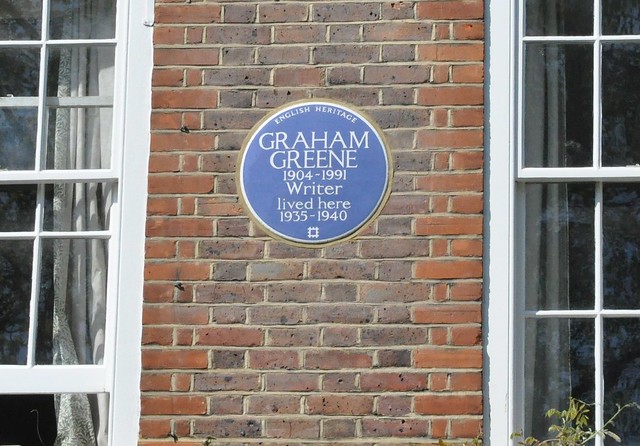
Graham Greene lived here!


Graham Greene lived here!
Originally uploaded by hedgiecc

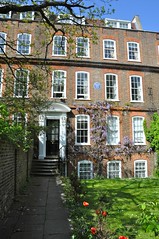
No. 14 Clapham Common North Side

The novelist received an official blue plaque from English Heritage last week.

"Graham Greene (1904-1991) lived at 14 Clapham Common North Side from 1935 until he was forced to leave the house due to war damage in 1940. His novel The End of the Affair is set in Clapham in 1945-6. The narrator lives in a bedsit 'at the wrong side of the Common' (South Side), drinks in the 'Pontefract Arms' (The Windmill) and visits 'the dark church at the corner of Park Road - a Roman Catholic church full of plaster statues' (St Mary's).
Writing to his mother, Greene describes Clapham thus: 'the whole appearance of Clapham Common is lovely, like a wide green plateau on a hilltop above Battersea with the Common stretching out in one direction and on three sides surrounded by little country-like shops and Queen Anne houses."

- from Clapham Past by Gillian Clegg


Greene lived here with his family from August 1935 to October 1940, when the house was bombed.

"The English Heritage blue plaque will be installed at 14 Clapham Common North Side, where Greene lived with his family from August 1935; at that time he described it as “a most beautiful Queen Anne house … done up absolutely like a museum piece”. It remained his home until October 1940 when it was hit in a bombing raid and became uninhabitable; the house was empty that night as Vivien and the children had been evacuated to Sussex and Graham was staying in Bloomsbury with his lover, Dorothy Glover. This devastating event later inspired the pivotal point in his novel, The End of the Affair. Despite the damage, the outer walls of the house remained intact, allowing the interior to be rebuilt after the war. The house is Grade II* listed and forms part of a terrace built by the architect John Hutt in 1714-20.

Greene’s daughter, Caroline Bourget, said of the house: ".... my father evacuated us to his parents' home in Sussex in August 1939 when I was only 5 yrs old......but I do remember the magnificent staircase. Some well-known writers and publishers visited the house such as John Betjeman and Evelyn Waugh. When I met them later, they recalled seeing me at the age of 3 or 4."

English Heritage blue plaque historian Dr Susan Skedd said: “Graham Greene is indisputably one of the great British writers of the twentieth century. He achieved the rare distinction of enjoying both critical and popular admiration throughout his career. Since the centenary of his birth in 2004 his literary reputation has been increasing and we hope this plaque will act as a focus for old and new fans of his work alike.”


Graham Greene lived here!

Saturday, April 09, 2011

A Cut Back

Carol Ann Duffy is definitely shaping up to be one of our most interesting Poet Laureates. I've quoted her amazing Last Post before, this one is her response to the Art Council's decision to cut all funding from the Poetry Book Society from April next year. It originally featured in the Guardian, and I'm quoting it from Belinda Hollyer's blog. Here's how you can help the Poetry Book Society.

A CUT BACK, by Carol Ann Duffy

It’s no go the LitFest, it’s no go up in Lancaster,
though they’ve built an auditorium (still quite wet, the plaster)
a bar, a bookshop, office space … well, they won’t need wheelchair
access.
All we want is a million quid and here’s to the Olympics.

London’s Enitharmon Press was founded in 1967,
but David Gascoyne and Kathleen Raine are writing now in heaven,
with UA Fanthorpe, John Heath-Stubbs; dead good dead poets all.
The only bloody writing now’s the writing on the wall.

It’s no go the national art, it’s no go cake with icing.
All we want are strategic cuts, it’s no go salami slicing.

It’s no go the Poetry Trust, it’s no go in East Suffolk;
Aldeburgh’s east of Stratford East. As Rooney says, oh f-fuck it –
because it’s no go First Collection Prize, it’s no go local writers.
We’ve been asked to pull the plug, the rug, by coalition shysters.

National Association of Writers in Education?
No way, NAWE, children and books, the train’s leaving the station.
It’s no go your poets in schools, it’s no go your cultures.
All we want is squeezed middles and stringent diets for vultures.

It’s no go the pamphlet, the gig in Newcastle no go.
All we want is a context for the National Portfolio.

Three little presses went to market, Flambard, Arc and Salt;
had their throats cut ear to ear and now it’s hard to talk.
They remember Thatcher’s Britain. Clegg-Cameron’s is worse.
Deathbyathousandcuts.co.uk, the least of which is verse.

It’s no go the avant-garde, it’s no go the mainstream.
All we want is a Review Group, chaired, including recommendations.

Stephen Spender thought continually of those who were truly great;
set up the Poetry Book Society with TS Eliot, genius mate.
But it’s no go two thousand strong in the Queen Elizabeth Hall.
Phone a cab for the Nobel laureates as they take their curtain call.

It’s no go, dear PBS. It’s no go, sweet poets.
Sat on your arses for fifty years and never turned a profit.
All we want are bureaucrats, the nods as good as winkers.
And if you’re strapped for cash, go fish, then try the pigging
bankers.

Monday, March 14, 2011

Shock


Watching Channel 4's Dispatches: Britain's Secret Fat Cats while blogging. I read and was very impressed by Naomi Klein's No Logo; however I missed out on her next book The Shock Doctrine when it came out. It seems to be cited more and more frequently these days though so I ordered it in from Amazon.

Basically, it appears to be Cameron and Clegg's playbook (with truly staggering amounts of Blairesque mendacity and spin of their own on top). Dispatches is showing, quite methodically and clearly, how government cuts will force privatisations which will enrich a very few at the expense of decent public services for all. One could perhaps argue that Reagan and Thatcher had genuine hopes of their "free-market" ideology actually working. However, 30 years later, after an economic apocalypse brought about by the very deregulation Thatcher and Reagan initiated, with middle and lower-class incomes over that time stagnating and even retreating while the top 1% soars exponentially ever higher, imposing the same policies without an explicit mandate is crassly stupid, if not criminal.

"A more accurate term for a system that erases the boundaries between Big Government and Big Business is not liberal, conservative or capitalist but corporatist. Its main characteristics are huge transfers of public wealth to private hands, often accompanied by exploding debt, an ever-widening chasm between the dazzling rich and the disposable poor and an aggressive nationalism that justifies bottomless spending on security. For those inside the bubble of extreme wealth created by such an arrangement, there can be no more profitable way to organize a society. But because of the obvious drawbacks for the vast majority of the population left outside the bubble, other features of the corporatist state tend to include aggressive surveillance (once again, with government and large corporations trading favors and contracts), mass incarceration, shrinking civil liberties and often, though not always, torture.

From Chile to China to Iraq, torture has been a silent partner in the global free-market crusade. But torture is more than a tool used to enforce unwanted policies on rebellious peoples; it is also a metaphor of the shock doctrine's underlying logic."

- Naomi Klein, The Shock Doctrine, 2007

Saturday, March 05, 2011

Quote London

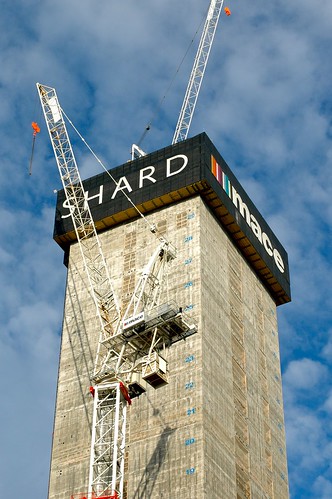
“I love that London is a city on the run - I think if you want to see a little bit of all the world, London is the best place for it; everything that's impossible becomes possible in London.”

~ Simona Visinskyte, worker on the Shard. (Quoted in Evening Standard 4/3/2011)

tower

Friday, December 31, 2010

New Year's Eve

CVI

Ring out, wild bells, to the wild sky,
        The flying cloud, the frosty light:
        The year is dying in the night;
Ring out, wild bells, and let him die.

Ring out the old, ring in the new,
        Ring, happy bells, across the snow:
        The year is going, let him go;
Ring out the false, ring in the true.

Ring out the grief that saps the mind,
        For those that here we see no more;
        Ring out the feud of rich and poor,
Ring in redress to all mankind.

Ring out a slowly dying cause,
        And ancient forms of party strife;
        Ring in the nobler modes of life,
With sweeter manners, purer laws.

Ring out the want, the care, the sin,
        The faithless coldness of the times;
        Ring out, ring out my mournful rhymes,
But ring the fuller minstrel in.

Ring out false pride in place and blood,
        The civic slander and the spite;
        Ring in the love of truth and right,
Ring in the common love of good.

Ring out old shapes of foul disease;
        Ring out the narrowing lust of gold;
        Ring out the thousand wars of old,
Ring in the thousand years of peace.

Ring in the valiant man and free,
        The larger heart, the kindlier hand;
        Ring out the darkness of the land,
Ring in the Christ that is to be.

        ~ from In Memoriam, Alfred Tennyson (1809-1892)

Saturday, July 10, 2010

Britain is not a passively accepting country

.
Still obsessing over the direction we are heading in economically - looks like we're heading for a perfect storm in a couple of years' time! I intend to periodically track our progress or otherwise to economic Armageddon. First up, this quote I spotted the other day from Prof Greg Philo:


"The slash and burn economics which we are now being offered will depress economic growth, since much of the stimulus for private enterprise comes from public spending. The public is likely to reject the cuts because they believe our problems result from the misdeeds of a wealthy minority. There is no political capital in asking the bottom half of the population which has only nine per cent of the wealth to pick up the bill through lost jobs and regressive taxation. Britain is not a passively accepting country; when in the past government policies have been seen as profoundly unjust, they have provoked social agitation. If this happens, the markets will be depressed even more and we move further down the economic spiral that the coalition with little mandate and less economic sense is now producing.

The UK has £5,500 billion of private wealth agglomerated in the top 20 per cent of the population, much of it in inflated property values making it effectively dead money. A far better way of tackling the deficit would be a radical tax on property, which would re-cycle some of this wealth back into the productive sector via government spending" - Prof Greg Philo, Glasow University Media Group, in the Evening Standard 6 July 2010(not on their website)

Saturday, May 08, 2010

the point of liberals

"In the realm of practical politics, two things must happen - both of which are likely. There must be one more General Election to disillusion Labour optimists as to the measure of their political strength, standing by themselves. But equally on our side there must be a certain change.

The Liberal Party is divided between those who, if the choice be forced upon them, would vote Conservative, and those who, in the same circumstances, would vote Labour. Historically, and on grounds of past service, each section has an equal claim to call itself Liberal. Nevertheless, I think that it would be for the health of the party if all those who believe, with Mr. Winston Churchill and Sir Alfred Mond, that the coming political struggle is best described as Capitalism versus Socialism, and, thinking in these terms, mean to die in the last ditch for Capitalism, were to leave us.

The brains and character of the Conservative Party have always been recruited from the Liberals, and we must not grudge them the excellent material with which, in accordance with our historic mission, we are now preserving them from intellectual starvation. It is much better that the Conservative Party should be run by honest and intelligent ex-Liberals, who have grown too old and tough for us, than by Die-Hards. Possibly the Liberal Party cannot serve the State in any better way than by supplying Conservative Governments with Cabinets, and Labour Governments with ideas," - J.M. Keynes, in a speech given to the Manchester Reform Club in February 1926.


- from Andrew Sullivan

Tuesday, February 16, 2010

Quote London

"The best seat in any theater in the world is the front seat on the upper deck of a London Omnibus."

- Henry James