Showing posts with label London. Show all posts

Thursday, September 01, 2016

Tribal Art London

The Tribal Arts London fair 2016 is now on in The Mall Galleries until the 4th September. It's a great opportunity to catch an eye-popping spread of Tribal Art all under one roof - areas covered include Africa, Asia and the Pacific. Entry is free but bring your wallet in case you are tempted to buy any of the masks, figurines, bronzes, textiles, ceramics or jewellery on display.

I dropped in to have a look and here are a few of the things that caught my eye. First of all, obviously, some African masks:

(Songye masks from the Congo)

Another Congo mask
A Pende dog mask
A spectacular Sowei/Nowo mask from Sierra Leone

This Fon bronze of a lion with its prey I thought was very elegant.


Exotic head gear!
A fascinating 'power object' - we in the West are more familiar with lovers' locks on bridges - a very different sort of magic I imagine.

The Zulu are very famous as a tribe but actually their art is quite rare - here is a fascinating 19th-century staff with a lion being hunted (top) and a zulu snuff box made out of horn with a metal lid.

Finally, this Ethiopian headrest I thought was striking in its beautiful shape and patina, with highly intriguing metallic adornments and repairs.

Sunday, November 01, 2015

Quote London

      
“A sprawling North London parkland, composed of oaks, willows and chestnuts, yews and sycamores, the beech and the birch; that encompasses the city’s highest point and spreads far beyond it; that is so well planted it feels unplanned; that is not the country but is no more a garden than Yellowstone; that has a shade of green for every possible felicitation of light; that paints itself in russets and ambers in autumn, canary-yellow in the splashy spring; with tickling bush grass to hide teenage lovers and joint smokers, broad oaks for brave men to kiss against, mown meadows for summer ball games, hills for kites, ponds for hippies, an icy lido for old men with strong constitutions, mean llamas for mean children and, for the tourists, a country house, its façade painted white enough for any Hollywood close-up, complete with a tea room, although anything you buy there should be eaten outside with the grass beneath your toes, sitting under the magnolia tree, letting the white blossoms, blush-pink at their tips, fall all around you. Hampstead Heath! Glory of London! Where Keats walked and Jarman fucked, where Orwell exercised his weakened lungs and Constable never failed to find something holy.”
- Zadie Smith, On Beauty

Saturday, January 31, 2015

Quote London - Stockwell Watchmen

It seems north Londoners have always felt a little bit nervous of security arrangements south of the river - I was mildly amused to come across this diary entry by Joshua Wingate Weeks for 30 January 1779:
"When the service was finished I took a walk on the other side of the river into the country as far as Stockwell which is a small village about 4 miles from London ... Vauxhall Gardens are also here, which we passed by. We dined at Stockwell & returned home by another road. It was late in the evening & the lamps which extended from London  to this place were lighted & formed a most august and beautiful appearance. At small distances watchmen armed with musquets are placed to prevent mischief & detect robberies & they have bells placed in such a manner as to give notice to each other by ringing them if any thing remarkable occurs, by which means they could readily come to each others assistance & be upon their guard to prevent the escape of any suspected person."

The security state has had a long history!

(Quote from A London Year: 365 Days of City Life in Diaries, Journals and Letters, compiled by Travis Elborough & Nick Rennison. Published by Frances Lincoln, 2013)

Monday, November 03, 2014

Quote London

"I arrived in 1978 from China, where the parks had been ransacked and cultivating flowers was condemned as a bourgeois habit. When I saw chestnut trees and expanses of lawn in London, I was almost mad with joy. These days I like to take a stroll in HYde Park, and I always end it by reading a book at the Orangery." - Jung Chang

Thursday, July 10, 2014

Sunset over the Thames

Midsummer evening, London. From Hungerford Bridge

Monday, July 01, 2013

Weekend

A weekend in London on the hinge of the year - bookended by two photographs -


Taken from the balcony of a stunning 17th-floor apartment in north London on friday evening. Night was falling but the looming clouds are deceptive - they were clearing rather than gathering:


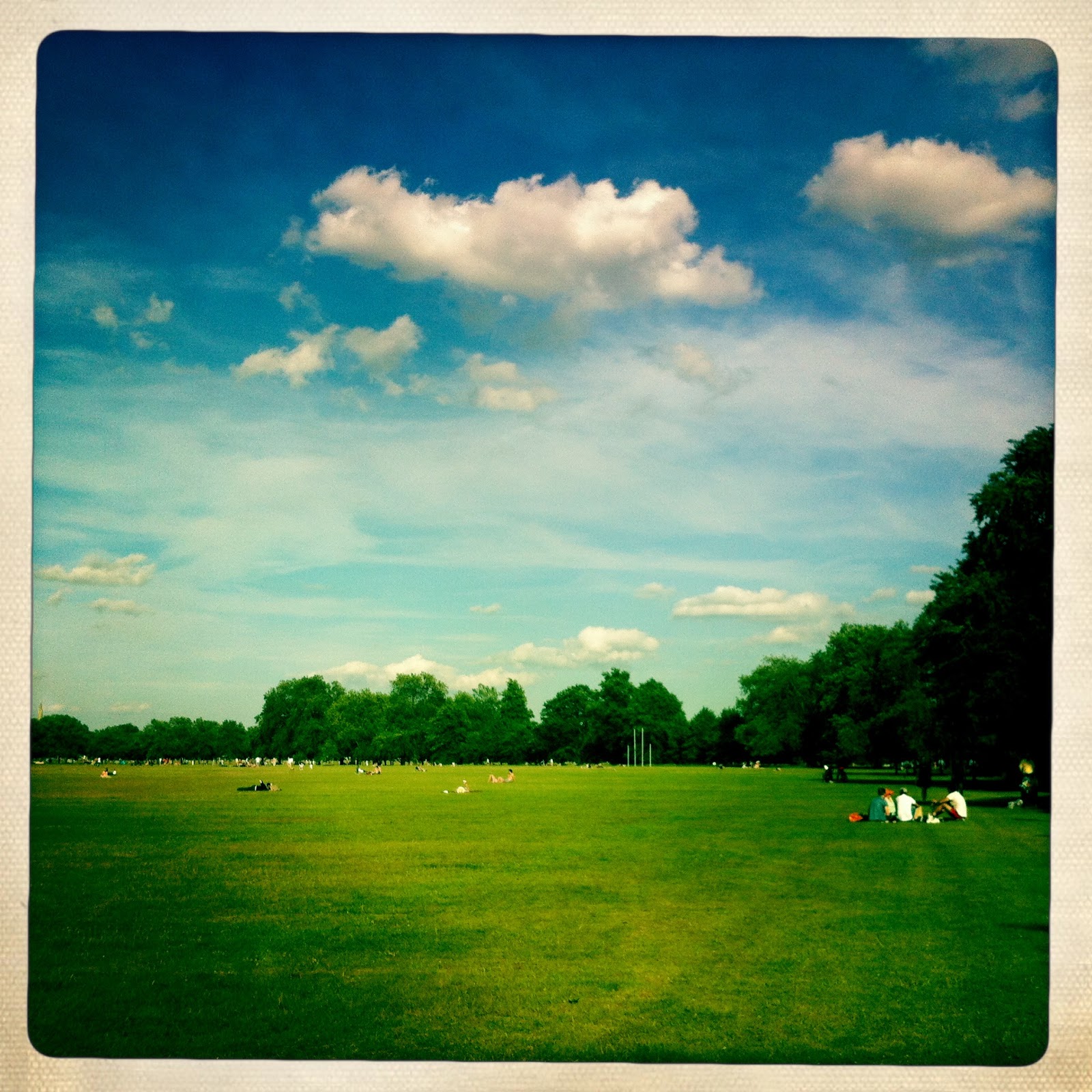
This is Clapham Common late on Sunday afternoon - flaming June finally arrived, if at the last minute.

In beween the two moments was Pride weekend, and I'll cover my Pride activities in forthcoming posts.

Tuesday, June 18, 2013

#guardiancoffee

The most Guardian headline of all time has recently been awarded to:

Can vegans stomach the unpalatable truth about quinoa?

I suspect the Guardian’s #guardiancoffee wheeze is going to generate some close competition.

The hashtag has already been amusing the twittershere for days. Huffpost claimed punters could meet Edward Snowden there for a latte; wags wondered if #guardiancoffee had anything to do with British intelligence’s faux internet cafes to spy on foreign diplomats.

Alex Hern of the New Statesman is insightful:

“If there was one thing the #guardiancoffee hashtag revealed, it’s that the Guardian starting a coffee shop in a container-based pop-up mall in Shoreditch is entirely unsurprising. It’s pretty much the perfect brand extension for them, reinforcing their image in the eyes of their target audience, middle-class metropolitan liberals, while only really damaging it for people who weren’t too hot on their politics anyway. … A coffee shop in Shoreditch is small fry. The Guardian is not. Clearly, there are reasons beyond simple revenue maximisation at play here.”

I think the idea is rather endearing, and hope it will work for them. Alex posits the location and environment will be good for techie types to meet in; the space could also operate as a quick ’n easy studio. It also serves as a space to meet the Guardian’s journalists for a coffee and a chat.

It seems the Guardian believes the future lies in the past - what they are doing, no less, is to reinvent the politically and socially activist 18th-century London coffee house for the 21st century.

I had no idea about all of this when I saw the invitation to apply to come for a morning coffee with Polly Toynbee. I’ve never won anything in a newspaper competition, but this time I did and an email from Guardian towers arrived with instructions to bring it to gain entrance.

The Shoreditch Boxpark concept is great - basically, a pile of reconditioned shipping containers are let out on a short-term basis to pop-ups, so there’s always something interesting and new going on there. The park is sited on Shoreditch High Street around the corner from the overground station and across the road from Shoreditch House. #guardiancoffee fronts on to the street, with massive Guardian branding on its glazing. It’s impossible to miss.

Inside, cut-through openings link the three adjacent containers which comprise the cafe. Inside is pretty cosy, with simple, wholesome wooden furnishings, techie-cool graphics wallpaper, and big screens wiring you up to the world on the walls (and iPads on the tables). A sort-of deconstructed cross between a Starbucks and an Apple shop.

The wall screen shows which coffees are most popular - the flat white had it by a mile, followed by the latte. I missed the reading for soy-based coffees.

There looks to be a good selection of cakes - as I was on the ‘2’ part of my 5-2 diet today I’ll have to sample them on another occasion. My invite swiftly, efficiently and politely dealt with at the door, it was a bit harder to get a coffee. Service seems to be provided by earnest young media intern types, not your usual Starbucks/Nero baristas, and I felt they were just getting into the swing of things. I eventually got one though, and took my seat in the throng around Polly. As one would expect, the Guardian is aiming at the artisan, quality end of the market. While good, the coffee is more expensive than Starbucks and comes in smaller cups.


The completely charming space doesn’t work that well for meetings of this sort - there were only thirty of us invited and some in the third container down struggled to catch comments made by those of us up at the front near Polly (and vice versa). However, the discussion did get going and developed a good flow - this concept could definitely work.

I was a bit nervous of trolls turning up but the group turned out to be very core Guardian-reader. They did a quick hands-up poll and interestingly the vast majority us were digital readers, and only a small minority CiF commenters. Polly asked who of us were political party members and a fair few were (I imagine not Tory).

So, amongst us lefty coffee drinkers the views were impassioned yet frustrated. There was definitely a feeling the left’s message wasn’t breaking through, and that in fact the left doesn’t appear to have a message at all. Poor Ed Milliband seems to bewilder and disappoint his natural supporters at the moment, and even Iraq made an appearance - all I can say is Ed apologised for the war at the best and earliest possible opportunity, but it is still unfortunately an albatross for the Labour Party several years later. Amidst all this angst Polly was a voice of calm and reason. Obviously, as a journalist with privileged insight into the daily mechanics of politics she is aware of how parties have to work hard to position themselves and not to give their best ideas away too soon before an election. But she strongly believed in the value of individuals participating in whatever way possible: clearly, campaigns such as UK Uncut have succeeded in setting the political agenda with even David Cameron now seeing the necessity to appear to do something about tax avoidance. Individual participation in group actions; independent discussions amongst friends, family and colleagues, all permeates out and moves the argument forward.

Monday, March 11, 2013

A London Weekend

However long you live here, London always throws up something new, surprising and fabulous. It’s diversity doesn’t stop at having the largest number of foreign communities resident - every Londoner’s specific interests are catered to in depth as well, allowing for wonderful crossovers, mashups and discoveries.


So this last weekend was a bit of a London mash-up for me. It started, as all good weekends do, on Friday evening. A friend treated me to a play at the National Theatre: This House by James Graham. This is not the sort of play I am usually interested in - contemporary, and about 70’s politics and House of Parliament procedures. My usual theatrical interests are Classics (deep!) and Stars (shallow!) - I recently took in James McAvoy’s Macbeth, covering both - so This House was completely off my radar until I saw a trailer for it at the cinema. It looked amazing! It turns out that it’s a National Theatre hit and had returned for a second run at the larger Olivier theatre.


We were lucky to get great seats in the auditorium. The staging has a block of parliamentary style benches on stage, and some lucky audience members get to sit on these - the blocks are on two of the Olivier’s revolves and swivel round for scenes set in the House for parliamentary votes. Most of the time they are flat on and the front of the stage becomes the Whips’ offices as they plot and scheme (Tories) or desperately try to keep things afloat (Labour).


The play covers events from the fall of Ted Heath to the rise of Margaret Thatcher, through the eyes of the Whips. The Tories are blasé, urbane, worldly, and have seen it all before. Born to rule. Witty, but prone to bullying their newbies and snobbish. They become increasingly nervous of the top dog as Thatcher entrenches her leadership (initially portrayed as a weird fluke they expected not to last).


The Labour side show mainly working class types and accents (and the only women MPs in the play). The men swear like sailor’s parrots and then apologise to the women, who get annoyed by the apologies. Wilson’s government had a wafer-thin margin and was expected to fall within weeks - however, it lasted 4.5 years, and the play shows the desperate lengths the Labour whips went to to keep it all together (and the lengths the Tories went to to take them down). It’s all very funny and engrossing but one is aware that Thatcher wins in the end and changes everything (the play ends with a recording of her famous victory speech in 1979).


We repaired afterwards for a debrief and cocktail at Skylon’s bar. I’ve not eaten in this restaurant in its current incarnation (I did before when it was run by a celebrity chef) - the room itself is so much more beautiful and glamorous now after the Royal Festival Hall refurb. It also benefits from the fifties revival trend. We quaffed fab cocktails, surrounded by Italians - so many of them around in London at the moment. Our discussions turned on the Parliamentary news of the moment - the spectacular and catastrophic fall from grace of Coalition minister Chris Huhne and his ex-wife Vicky Pryce, dubbed “the Clytemnestra of Clapham”. Indeed this is a greek tragedy, with both parties being sentenced to a jail term for perverting the course of justice today (over a speeding ticket in 2003!), but all their family dirty laundry has been fully aired in the press over the last few months. The Huhnes’ marital home was actually quite near to me, I’m familiar with their street in a “would love to live there’ kind of way. I also lived for many years with someone who went back and forth to Europe frequently, and would no doubt have known the stretch of road Huhne was caught speeding in (luckily, my housemate had a driver to ferry her to and from the airport so speeding was never an issue).


So far, so usual for me but Saturday would see me yanked right out of my usual tracks.


My niece is in a women’s eights team (Cantabridgian juniors) and was booked to race in the Womens’ Eights Head of the River Race (WEHORR) on Saturday. I’m vaguely aware of the Oxford/Cambridge boat race at the end of March but it appears that the whole of March is a big racing month on the Thames for rowers. My knowledge of rowing is not extensive (I called them ‘paddles’ and was put firmly right by a rowing mother - they are correctly called “blades”).

I met my brother and sister-in-law at the Battersea Affordable Art Fair where they had just made a purchase, and we taxi’d to the finish line at Putney Bridge just as the first boats arrived.


There were around 330 boats taking part. A ‘head’ race means they aren’t all actually starting at the same time - they are let go in batches in number order, so are racing against the clock. Coxes and teams use “Cox Boxes” to monitor their progress. The race goes downstream from Chiswick to Putney (the Oxford/Cambridge race goes upstream but timed to start on an incoming tide).


There was a great atmosphere amongst the crowds of supporters, and the sight of all the boats on the Thames was magnificent. we were treated to watching them sprint for the finish line in front of us and then double back past us to where they disembarked.


It took hours though for them all to come through, and the temperature noticeably dipped throughout the afternoon. After my niece’s team sailed past (they did well and were rightly proud of their achievement in their first big race, even with a broken cox box), we supporters all repaired to The Duke’s Head pub for a very late lunch.


The Duke’s Head is a quintessential rowers’ pub, and makes the most of its prime position on the start line of the Oxford/Cambridge boat race with a magnificent dining room - soaring ceiling and massive windows on three sides overlooking the river - and racing paraphernalia as decoration. The pub nails its colours firmly to the mast with its walls a Cantabridgian light blue.


Lunch/dinner was a hugely welcome wild boar burger with triple fried chips and a bowl of “allotment vegetables” - chanterey carrots, savoy cabbage and french beans. I toasted my niece’s team’s performance with a glass of sauvignon blanc, even as said team was whisked back to Cambridge thoroughly exhausted from their 4 hours on the icy river.

Tuesday, January 01, 2013

Happy New Year


Happy New Year!

Onwards and upwards: it's our annual chance to forget all the troubles of the past year, start anew and to dream big again. May it bring happiness to us all. It looks like it's going to bring the long-awaited Abba Museum to Stockholm, which is another reason to visit Sweden again (along with the Eurovision Song Contest in Malmö this May).

My new year was very mellow, as I didn't feel like venturing out of the warmth into rain-drenched London town to see the fireworks or do any parties. Instead I paid culinary tribute to my half-Polish origins by making a batch of placki kartoflane (pronounced PLAHTZ-kee kar-taw-FLAH-neh) and washing them down with Winter Pimms (this representing my English half). The pancakes were a huge treat when I was a child - I remember it was my dad's job to grate the onions; my mum would then mix the grated onion with grated potatoes, a tablespoon or so of flour, salt, pepper, and an egg or two and then fry the batter in a deepish slick of hot oil until the pancakes were crispy golden brown on the outside and meltingly soft inside. I think the grated vegetables allow more mixing with the fat and therefore possibly an even higher fat content than French Fries (the pancakes also take quite a lot of salt).


These days I drain them on kitchen paper before eating, and limit myself to one batch a year - usually in the winter when one needs a bit of mental and physical insulation.

I also pace myself - two medium-size baking potatoes' worth of placki go quite a long way, although they are very moreish. So the batter sits by a pan all evening - heating up the pan and frying a batch of three placki is the work of minutes (getting rid of the excess poundage from one's waistline will of course take months).

With friends and relatives spread out now across the globe, new year greetings, texts and calls started coming in at 2pm (Australia), followed by India, Zanzibar, South Africa, The Netherlands, and then finally Los Angeles. It was fun to feel the New Year wash over the globe like a gigantic wave. The world seems a lot smaller than when I was a child.


Now, of course, cities compete on YouTube for the best fireworks display - with Sydney and London being the most competitive. London's was extraordinary, if slightly spoilt by all those Tory voiceovers. New Year's fireworks as State propaganda. Oh well, at least it was over in 12 minutes!

Sunday, June 24, 2012

Jubilee

Well, this month saw the Diamond Jubilee of the Queen - London was positively awash with festivity (as well as rain). Here are some of my photos of the Jubilee preparations.
All of London is excited for HM Queen Elizabeth II's Diamond Jubilee
Official Jubilee Shop in Hyde Park
Union Flags lining the Mall
Stage set up outside Buckingham Palace for the BBC Jubilee Concert
Covent Garden
Adjusting the flags in the Apple Market, Covent Garden
A Classic Jubilee entrance to Harvey Nichols
Witty Jubilee windows by L.K. Bennett, one of Kate Duchess of Cambridge's favourite shops
Harrods made a full-scale Jubilee effort with its store decorations

A Jubilee crown designed by Paul Smith in the Windows of Harrods. Harrods commissioned international designers to each design a crown for the retailer's Knightsbridge store's windows.
Oxford Street, London
God Save The Queen in Selfridges windows
A colourful corgi getaway in Selfridges windows
The Changing of the Guard in Selfridges windows

Jubilee-themed windows in Ann Summers
Bond Street
Lever House lavishly decorated with Union Flags
The Thames the day before the flotilla pageant. The giant photograph was of the royal family on the balcony at Buckingham Palace during the Silver Jubilee.
Early (hardy) birds for the Jubilee flotilla river pageant - a full 25 hours before the event, with arctic temperatures and heavy rain forecast
A splendid array of alcoholic drinks and party paraphernalia in the window of Laithwaites
Konditor & Cook's Jubilee cakes

London Underground poster

The Jubilee week cover of TimeOut Magazine

Quote London

“We seek cities because there are a greater range of girls at the bar, of reproductive choice. Number one. Number two is there are better outcomes for health and wealth. And now we care more about the environment, and cities are better for the environment. But above all, talented people seek cities for fame. They can’t get famous in the fucking village.”
- Boris Johnson, Mayor of London, in New York Magazine

Tuesday, May 15, 2012

Boris's brush with art criticism

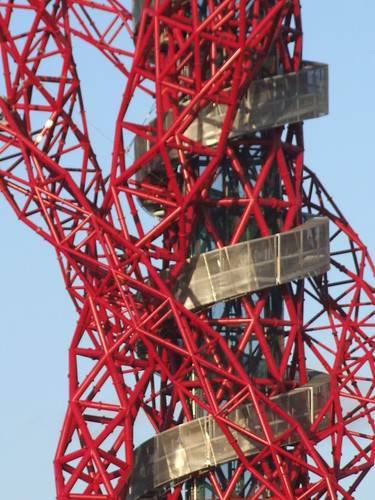
OrbitYesterday Boris Johnson wrote such an extraordinarily provoking column in The Telegraph and on his blog that I broke a lifetime’s resolve and left a comment (on the blog). A couple of hours later my comment disappeared, so I thought I may as well vent my reactions more fully on my own blog.
.
In his column Boris reacted to two small criticisms made of the AcelorMittal Orbit by the BBC’s arts correspondent Will Gompertz: he felt it was too small and was a pity entry wasn’t free (Anish Kapoor, the Orbit’s sculptor, is on record as being against the entry fee too). Boris’s bile knew no limits and from these minor and entirely reasonable personal comments Boris concluded that the BBC as an organization was biased towards the Labour Party and that the next BBC chief must be a Tory.
.
I’m very disappointed in this; I hope his column was flung off two minutes to deadline (apparently a common practice) and doesn’t represent Boris’s considered opinion. I imagine he would have lost a few votes if this had come out before the election.
.
The BBC was set up during the last major financial crisis in the 1930s by a political establishment concerned to neutralise extremist views in the UK media. They succeeded brilliantly. However it seems the modern Tory’s attitude to public service broadcasting is far closer to that of Goebbels and Stalin than it is to their own Tory forebears. Today’s Tories are clearly absolutely determined to create a Fox News in the UK – with all the consequent divisive coarsening of public debate that will result. It’s worth noting the BBC had its worst clash ever with the (Labour) Blair Government over Iraq – and despite the Hutton enquiry the public still believed the BBC’s version over Tony Blair’s. To this day the BBC remains the most trusted news source for the British public - vastly more trusted than, say, The Telegraph itself.
.
Boris complains the BBC is suspiciously interested in the Leveson enquiry despite the public not being that interested.
.
Whether or not the public is interested in the Leveson enquiry, the apparent wholescale corruption of our political classes, the police, and the intimidation of celebrities and members of the public alike are clearly issues which go to the heart of our democracy, as Boris as a senior politician should realise.
.
Boris also claims that public funding somehow corrupts the BBC. As Boris’s Mayoral salary is also publicly funded, and he enjoys a generous £250,000 per year from The Telegraph for his journalism, will he abstain from claiming his Mayoral salary? - Mrs Thatcher of course didn’t claim her salary as PM back in the 80s.
.
About the Orbit I tend to agree with him that it’s better and more interesting close up – at least as far as I could see from the BBC television pictures. However, you can’t have it both ways – it’s either a monument to the public munificence, advanced aesthetic taste and civic pride of Mr Mittal and Boris Johnson or it’s a commercial fee-paying attraction. As Boris knows, the famous bread and circuses of ancient Rome were free to Roman citizens - that was the entire point. The London Eye was always meant to be a fairground ride – the Orbit is supposed to be public sculpture. And the £15 entry fee is on top of the £10 fee you have to pay to get into the Olympic grounds – so despite what Boris claims it does work out as considerably more expensive than the Eye to go up a not very tall stationery tower. Boris should have insisted on slides!
.
Boris’s tiresome diatribe has been dissected brilliantly by Dave Hill in The Guardian, who particularly points out Boris’s dodgy denial of any links to Rupert Murdoch’s News International during his election campaign. Boris’s full-throated diatribe against the BBC will, of course, endear him to the Murdochs père et fils, whose long-term objective is to eliminate their rival media organization in order to maximize their own personal profit and influence.

Saturday, March 17, 2012

Quote London

"But London has cause to feel particularly proud of the thrusting generation of moderates whom the capital shaped in various well-endowed institutions and at soirees held in their honour at the highest level of metropolitan society, before sending them off into the Middle East to work their magic. Think of Saif Gaddafi, Bashar al-Assad and his wife – perhaps Vanity Fair, which last insisted London was swinging in 1997, could return to do a sarcastic "Class of" feature on the capital's most eye-catching governance alumni.

It took root under Thatcher but it was Blairism that presided over the capital's transition into full-blown creep haven – inevitable, given Tony's pathological admiration for the super-rich. The result is that it is now standard to note that there are two Londons: the one where all but a few thousand of the city's millions live, and the one where, when yet another Mayfair restaurant opens selling £70 steaks, the black Range Rovered clientele cannot get a table for weeks on end.

From the outside, the one increasingly eclipses the other. And thus, if I might make a pitch for inclusion in Pseuds' Corner, London is contracting as an idea. Where previously outsiders could get a sense of the richness of the city's culture, it is now increasingly difficult to get a sense of much else than London's richness – while for insiders, the sense of exclusion from that richness becomes more pronounced. The greatest city in the world does not care to accommodate its key workers within a one-hour, overpriced commute of their jobs, but plays enduringly attentive host to some of the most grotesque horrors of the age."

- Marina Hyde in the Guardian

Wednesday, February 22, 2012

Design Museum Heads West

The Design Museum is in the news because of its annual Design Awards (Designs of the Year 2012 exhibition now on at the Museum) and because the museum itself is on the move across London from Shad Thames to the old Commonwealth Institute in Holland Park - its best frenemy the V&A will be a near neighbour in South Kensington (target date 2014).

While part of me is thrilled that someone is giving this mad 50s folly a new lease of life (Grade II listed, no less, and apparently regarded as second only to the incomparable Royal Festival Hall in post-war British Modernist importance), the bigger part of me is sad the Design Museum will be leaving Shad Thames, which it has graced since the 1980s. I imagine it will be replaced with more expensive flats with river views, impoverishing the cultural life and diversity of this stretch of the Thames immeasurably.

Also worrying is what they intend doing to the old Commonwealth Institute building (Sir Robert Matthew, Johnson-Marshall and Partners, 1960-2) , an architect’s flight of fancy if ever there was one, a triumph of form over function or even reason:

“Regarded by English Heritage as the second most important modern building in London, after the Royal Festival Hall, the building has a low brickwork plinth clad in blue-grey glazing. Above this swoops the most striking feature of the building, the complex hyperbolic paraboloid copper roof, made with 25 tonnes of copper donated by the Northern Rhodesia Chamber of Mines. The shape of the roof reflects the architects' desire to create a "tent in the park" . . . The interior of the building consists of a dramatic open space, covered in a tent-like concrete shell, with tiered exhibition spaces linked by walkways. “


Those links include swooping stairs down to a floating mezzanine level beneath the immense expanse of that magnificent roof. This grand flourish is extravagantly wasteful of space, which no doubt the Design Museum covets. The proposed remodeled interior designs I have seen sweep away the stairs, walkways, floating mezzanine, etc, and close up that central block of empty space. The original complex and delightful spatial interplay is completely annihilated in favour of a grim heavy concrete platform with a rather mingy oculus allowing a partial view of the roof. My criticisms are purely aesthetic here - no doubt in practical ways the redesign will make the space function far more efficiently as a gallery, as well as generating more usable floor space. It’s just sad that something so intrinsic to the building will apparently vanish in the process. John Pawson has a lot riding on this - a very modish architect, most of his projects so far have been either commercial or private commissions by the super rich; this will be his first major public project. His brand of highly aesthetic minimalism seems a refinement of 60’s Brutalism - the movement which reacted forcefully against the effete and almost rococo modernism represented by the Commonwealth Institute. We shall see whether the styles can harmoniously cohabit.

Friday, August 26, 2011

Quote London

“Once, she had thought she could conquer London. She had imagined a whirl of literary salons, political engagement, larky parties, bittersweet romances conducted on Thames embankments. She had intended to form a band, make short films, write novels, but two years on the slim volume of verse was no fatter, and nothing really good had happened to her since she’d been baton-charged at the Poll Tax Riots. The City had defeated her, just like they said it would. Like some overcrowded party, no-one had noticed her arrival, and no-one would notice if she left.”
David Nicholls, One Day


The Guardian mocked the trailer mercilessly, but I loved it! It inspired me to get the novel, which I am currently enjoying very much. The reviews of the film have been disappointing - The Guardian crucified it - and already there have been features on “the most disappointing novel adaptations” (possibly in The Guardian as well - I’m sensing a pattern forming here ) so I may vey well miss the movie.

Anne Hathaway’s charmless claim in a red-carpet interview the most difficult thing about her role was getting the bad British posture right put me off as well. What, Ms Hathaway, even more difficult than the accent?

Saturday, August 13, 2011

Some thoughts on the recent disturbances

Nick Clegg predicted these riots would happen under a minority Tory Government during last year’s election campaign, of course. But going back to 2006 even David Cameron appeared to suggest there was a social context to youth crime, in his “hug a hoodie” phase. But now the riots for him are criminality, “pure and simple”, and he resists calls for public enquiries even as he outlines a programme of hysterical populist authoritarianism going forward. So far so depressing.

A pinko liberal like me will point to the fact that the riots overwhelmingly happened in poorer areas and the rioters tended to be unemployed, and argue this must mean social deprivation and blighted prospects must be relevant to understanding the causes of these disturbances. However, it will be pointed out (correctly) that the vast majority of poor people do not riot and steal, whatever the provocation.

It is true criminality exists at all levels of society. Criminals selfishly take to enrich themselves at others’ expense, if they calculate they will get away with it. Most violent crime happens at lower levels, but as one rises in the social pecking order there are greater opportunities for non-violent crime, and for immoral acts which just tidily skirt the edges of the law. For instance, I feel there is an exact moral equivalence between MP’s looting public funds for plasma TVs on their expenses and Tottenham rioters looting Curry’s.

Peter Oborne brilliantly expands on this point:

“The culture of greed and impunity we are witnessing on our TV screens stretches right up into corporate boardrooms and the Cabinet. It embraces the police and large parts of our media. It is not just its damaged youth, but Britain itself that needs a moral reformation.”


For thirty years and more we have been told that “greed is good” (personal greed being the driver of neo-liberal economics) and we have witnessed decades of consumerist excess. We are what we consume. So now we have “shopping with violence” by those excluded from the system and a “grab what you can while you can” attitude in our politicians, businessmen and bankers.

Rupert Murdoch’s media empire, in plain sight, debauched the integrity of our political classes from Thatcher in the 80’s (who broke the rules and allowed News International to take control of The Times and Sunday Times) to just this year, when until the scandal broke the Cameron government gave every indication of breaking every sinew in order to give Murdoch the full ownership of BSkyB without legal examination.

While this trail of political corruption was there for everyone to see - most lefties have been yammering on about it for years - what shocked me was they way in which the Metropolitan Police were corrupted by News International too.

So now Britain has a superstructure of morally bankrupt politicians, police, media and bankers presiding over a rioting underclass. We truly are in dire straits.

But it seems to me the police have been corrupted from another direction too. Before she launched into her vast social engineering programme, Thatcher gave the police massive pay increases, and given the amount of social unrest during the 80s this was clearly an astute Machiavellian ploy. However, Cameron’s crew were more naively neo-liberal than the blessed Margaret and decided the police were a social expense they wanted to cut (by 20%). The strangely tentative police reaction to the start of the rioting (rioters in Clapham were left alone for hours, for example, despite prior knowledge of the intended attacks) suggests a possible intention on their part to put some pressure on the Government over the cuts; certainly the PR war between police and government in the last few days appears to support this interpretation too.

Which is another cause for alarm. Under Blair we saw an huge increase in the political import of the police - and indeed political policing. Now it could be argued the police are holding the government to ransom. I’m not a fan of Cameron at all but it is completely outrageous that the (unelected) police [service] should feel empowered to publicly argue with the elected representatives of State. I’m reading a book about the downfall of the Roman empire at the moment and it struck me we are not a million miles away from the Praetorian Guard deposing the Emperor because their pay rise wasn’t big enough.

Riots have a long history in Britain, and our beloved tv period dramas have occluded the extent of rioting in the vastly unequal Victorian and Edwardian eras. The 1886 Riot (Damages) Act allows for victims to claim compensation from the police if they were insufficiently protected. It is interesting that lawmakers of the time came up with this idea. They were clearly responding to a perceived need.

Back in those days, police and rioters were probably evenly matched in terms of technology. The 20th Century saw the police attain total dominance in technology, organization, tactics and training over potential rioters, culminating in the controversial kettling tactics of the last couple of decades.

However, we should remember the Black bloc anarchists who infiltrated the Anti-Cuts March back in March this year successfully trumped the police kettling tactics. The black bloc people ran amock in small groups throughout the city, popping up all over to cause havoc, then melting away only to reappear elsewhere. No black blocs were arrested, despite them being the major perpetrators of political violence that day. Instead, the police chose to arrest around 300 entirely peaceful UK Uncut protestors staging a sit-in in Fortnum & Masons (highlighting Fortnum’s non-payment of UK tax). These arrests were massive headline news at the time. Subsequently, all charges against everyone arrested there were dropped.

Clearly, those arrests formed a PR mask for police failure, and the current riots demonstrate anarchist black bloc tactics have by osmosis been absorbed by criminal elements intent on looting, with similar expectations of success. The only successful police response to this was an eventual massive increase in manpower on the streets - 16,000 on the streets of London this week, more than ever in history and three times more than usual. This is not sustainable long-term and police will be thinking of new tactics to contain rioters.

But until new, successful and cost-effective tactics are developed, and underlying social injustices are addressed, I expect to see more events of this kind. The initial riots were copied very quickly and very widely. Until then we will have to suffer populism of the “ban twitter and facebook” kind, even though it could be argued tv news coverage poured more petrol on the flames than social media ever did.

Friday, July 22, 2011

R.I.P. Lucien Freud

One of the greats passed away sadly on Wednesday evening. From his obit in the Guardian:

"Freud described the move to England as "linked to my luck. Hitler's attitude to the Jews persuaded my father to bring us to London, the place I prefer in every way to anywhere I've been.""

Thursday, May 12, 2011

Ai Weiwei - Circle of Animals/Zodiac Heads

.
Ai Weiwei's magnificent ceramic sunflower seed installation at Tate Modern has just ended, and today his first monumental bronze outdoor installation, Circle of Animals/Zodiac Heads opens to the public in the courtyard of Somerset House, having just been to New York and Sao Paolo.


"Designed in the 18th century by two European Jesuits serving in the court of the Qing dynasty Emperor Qianlong, the twelve zodiac animal heads originally functioned as a water clock-fountain, which was sited in the magnificent European-style gardens of the Yuanming Yuan. In 1860, the Yuanming Yuan was ransacked by French and British troops, and the heads were pillaged. In re-interpreting these objects on an oversized scale, Ai Weiwei focuses attention on questions of looting and repatriation, while extending his ongoing exploration of the “fake” and the copy in relation to the original."


The installation is a real triumph - very imposing physically, and richly layered conceptually - a wonderful icon of the way cultural exchanges happen through the centuries. It can only add to this most prominent contemporary Chinese artist's global reputation.


So it is absolutely extraordinary that at this exact moment the Chinese authorities have chosen to 'disappear' the artist - he hasn't been seen or heard of since the 3rd of April when he was arrested while boarding a flight to Hong Kong.

Gwyn Miles, Director of Somerset House Trust, has issued this statement:
"Like everyone who admires and respects the work of Ai Weiwei we are dismayed and aggrieved by the news that he has been detained by Chinese authorities. We deplore the actions taken against Ai Weiwei and his friends and colleagues, and indeed any curtailment of individual’s human rights. We are very concerned about their safety and wellbeing and ask for information on their whereabouts to be released and them not to be detained without a fair trial."

"Ai Weiwei has chosen and approved the installation set up for Circle of Animals at Somerset House and the works have already been shipped to the UK. The sculptures will be installed as planned and Circle of Animals will open to the public on 12 May. We believe that more than ever, his work should be seen and appreciated by as many people as possible."


Anish Kapoor, one of our leading sculptors, has issued a call to action by artists and the world's cultural organizations:

"As a colleague – I don't know him personally – I feel that as artists we have a communal voice and it's important that we stick together, that we have a sense of solidarity with each other," he said.

"It would be nice to see the art world come together a little more. Perhaps all museums and galleries should be closed for a day across the world. I think some such campaign needs to form itself."

Kapoor said the Chinese state's behaviour was reminiscent of the Soviet era, when "the voice of artists of different kinds was seen as being dangerous".

He added: "It does bear witness to the barbarity of governments that if they're that paranoid they have to put away artists. It's a ridiculous situation."


The situation is very distressing. China should view this artist as a tremendous asset to its image and growing cultural reach in the world.

I do recommend popping along to the exhibition at Somerset House. I particularly enjoyed they way they have chosen to exhibit the scultures next to fountains, as an echo of how the originals were designed to be viewed.