It seems north Londoners have always felt a little bit nervous of security arrangements south of the river - I was mildly amused to come across this diary entry by Joshua Wingate Weeks for 30 January 1779:
"When the service was finished I took a walk on the other side of the river into the country as far as Stockwell which is a small village about 4 miles from London ... Vauxhall Gardens are also here, which we passed by. We dined at Stockwell & returned home by another road. It was late in the evening & the lamps which extended from London to this place were lighted & formed a most august and beautiful appearance. At small distances watchmen armed with musquets are placed to prevent mischief & detect robberies & they have bells placed in such a manner as to give notice to each other by ringing them if any thing remarkable occurs, by which means they could readily come to each others assistance & be upon their guard to prevent the escape of any suspected person."
The security state has had a long history!
(Quote from A London Year: 365 Days of City Life in Diaries, Journals and Letters, compiled by Travis Elborough & Nick Rennison. Published by Frances Lincoln, 2013)
While watching the Westminster Abbey service tonight I got the urge to light a candle. Both my grandfathers fought in WW1, on opposing sides. My English grandfather ran away from home and lied about his age to get into the Royal Flying Corps (the forerunner of the RAF). He survived the war and remained in the RAF for the rest of his career, retiring in the 1950s. My Polish grandfather regarded himself as Prussian and fought in the German army. He survived a gas attack, but his lungs were severely compromised. He was a farmer by vocation and ended up on a glorious smallholding in the hills above Durban, South Africa. He sent me boxes of his home-grown passion fruit when I was a child. Both grandfathers died in the 1970s.
And that was the sum total of our family's history with WWI, or so I thought. Recently my brother and I have been tracing our family tree, and I was pretty surprised to find I had a grand-uncle Percival living at home in the schoolhouse at Slapton Sands, Devon, in the census of 1911 (My great-grandparents were the school teachers there). He was a tailor's apprentice. He was born in 1894, so was peak age for cannon fodder in the war. He died somewhere in 1916. I still have to follow up all the details.
The odd thing is no one in my family ever mentioned him. My grandfather never said a word. I don't think my father or his sister Patricia even knew of Percy's existence - my aunt Patricia had a huge fund of family stories and was interested in all the connections so I feel certain she would have said something about him if she had known.
Poor Percy. In memory of his short life and miserable death, a candle tonight.
Thanks, Your Majesty, for the Royal Assent. You soon won't be the only married queen in Britain. Hurrah, hurray hurroo! #EqualMarriage
— Stephen Fry (@stephenfry) July 17, 2013
"Where there is discord may we bring harmony. Where there is error, may we bring truth. Where there is doubt, may we bring faith. And where there is despair, may we bring hope." - Margaret Thatcher, on first entering 10 Downing Street as Prime Minister (paraphrasing the prayer of St Francis)
“To me, consensus seems to be the process of abandoning all beliefs, principles, values and policies. So it is something in which no one believes and to which no one objects.” - Margaret Thatcher
“Yes I do believe in consensus, there should be a consensus behind my convictions.” - Margaret Thatcher
Today her nation buries Margaret Thatcher, and I hope no one gets hurt or does anything stupid. Britain has in the past been adept at buying its departed politicians quietly, decently and without partisan rancour. Ceremonial is strictly for the Royals and national heroes like Winston, Horatio and Wellington. Not this time, unfortunately.
Margaret Thatcher is undoubtedly one of the greats - the first woman Prime Minister of Great Britain, and an ideological warrior and a game-changer. She’s been out of office for almost a quarter of a century, and retired from public view for almost a decade, but still the -ism that bears her name rules this country, with all three main political parties signed up to its basic tenets (and the insurgent party, UKIP, loudly proclaiming itself to be her true heir).
She revelled in partisanship while in office and lived for arguing her point of view. Ultimately her own cabinet, exhausted and terrified of where she was leading them, threw her out. Her opponents never got the chance to vote her out, and the treacherous Tories subsequently tore themselves apart in guilt and revenge.
Hence the ugly atmosphere and our heavy collective mood. Our Tory Prime Minister, who ironically was bequeathed these bombastic funeral plans by his New Labour predecessors, has equally ironically achieved no poll bounce off the back of a full week’s media Thatcher fest. Both right and left wing editorialists have decried the grandeur of the funeral, and it seems all those Thatcher TV shows actually achieved poor ratings. Some left wingers have shocked the world with their “Thatcher Death parties” and campaigns to get “Ding Dong the Witch is Dead” into the pop charts; equally, elements on the right wing have invited scorn by whinging Obama isn’t showing enough respect and drooling over the decidedly dicey D-list ragtag assortment of celebs, ex-cons and has-beens invited. The Tory chairman Grant Schapps wrote a letter out to all the constituency faithful to come and line the route this morning: are they frightened that no-one in London apart from the protesters will actually be brave enough to face the hyped-up police and security?
I’ve been immersed in it all, trying to make some kind of sense of what Maggie means to me. I don’t think we are quite there yet. She was a massive force, and did some things very right and some things very wrong. Her legacy is still unwinding and we are in its wake - it may take another thirty years before we can start to sum up. I think she is a transformative figure, up there with William the Conqueror, Henry VIII, and Oliver Cromwell. Massive winners and massive losers, always destined to be radically reinterpreted for every generation.
But I do think that her political analysis of the 70s wasn’t that remarkable - in fact, it was pretty close to being the consensus view. It is clear successive moderate Conservative and Labour governments could see exactly what they needed to do (and some of Thatcher’s most eye-catching policy innovations were in fact first thought of by Labour). They all failed, lost their nerve. And government failure is important, in that it doesn’t return things to where they were before - it moves them on: in this case driving extremism on both left and right. And Thatcher herself was the insurgent candidate from the far right of her party, and the era’s political genius to boot. So she won, and got to apply the ‘cure’ (a readjustment of the economy both parties knew had to be made) her way, through extreme radical ideological methods, tearing apart the country in the process and leaving us where we are today.
However long you live here, London always throws up something new, surprising and fabulous. It’s diversity doesn’t stop at having the largest number of foreign communities resident - every Londoner’s specific interests are catered to in depth as well, allowing for wonderful crossovers, mashups and discoveries.
So this last weekend was a bit of a London mash-up for me. It started, as all good weekends do, on Friday evening. A friend treated me to a play at the National Theatre: This House by James Graham. This is not the sort of play I am usually interested in - contemporary, and about 70’s politics and House of Parliament procedures. My usual theatrical interests are Classics (deep!) and Stars (shallow!) - I recently took in James McAvoy’s Macbeth, covering both - so This House was completely off my radar until I saw a trailer for it at the cinema. It looked amazing! It turns out that it’s a National Theatre hit and had returned for a second run at the larger Olivier theatre.
We were lucky to get great seats in the auditorium. The staging has a block of parliamentary style benches on stage, and some lucky audience members get to sit on these - the blocks are on two of the Olivier’s revolves and swivel round for scenes set in the House for parliamentary votes. Most of the time they are flat on and the front of the stage becomes the Whips’ offices as they plot and scheme (Tories) or desperately try to keep things afloat (Labour).
The play covers events from the fall of Ted Heath to the rise of Margaret Thatcher, through the eyes of the Whips. The Tories are blasé, urbane, worldly, and have seen it all before. Born to rule. Witty, but prone to bullying their newbies and snobbish. They become increasingly nervous of the top dog as Thatcher entrenches her leadership (initially portrayed as a weird fluke they expected not to last).
The Labour side show mainly working class types and accents (and the only women MPs in the play). The men swear like sailor’s parrots and then apologise to the women, who get annoyed by the apologies. Wilson’s government had a wafer-thin margin and was expected to fall within weeks - however, it lasted 4.5 years, and the play shows the desperate lengths the Labour whips went to to keep it all together (and the lengths the Tories went to to take them down). It’s all very funny and engrossing but one is aware that Thatcher wins in the end and changes everything (the play ends with a recording of her famous victory speech in 1979).
We repaired afterwards for a debrief and cocktail at Skylon’s bar. I’ve not eaten in this restaurant in its current incarnation (I did before when it was run by a celebrity chef) - the room itself is so much more beautiful and glamorous now after the Royal Festival Hall refurb. It also benefits from the fifties revival trend. We quaffed fab cocktails, surrounded by Italians - so many of them around in London at the moment. Our discussions turned on the Parliamentary news of the moment - the spectacular and catastrophic fall from grace of Coalition minister Chris Huhne and his ex-wife Vicky Pryce, dubbed “the Clytemnestra of Clapham”. Indeed this is a greek tragedy, with both parties being sentenced to a jail term for perverting the course of justice today (over a speeding ticket in 2003!), but all their family dirty laundry has been fully aired in the press over the last few months. The Huhnes’ marital home was actually quite near to me, I’m familiar with their street in a “would love to live there’ kind of way. I also lived for many years with someone who went back and forth to Europe frequently, and would no doubt have known the stretch of road Huhne was caught speeding in (luckily, my housemate had a driver to ferry her to and from the airport so speeding was never an issue).
So far, so usual for me but Saturday would see me yanked right out of my usual tracks.
My niece is in a women’s eights team (Cantabridgian juniors) and was booked to race in the Womens’ Eights Head of the River Race (WEHORR) on Saturday. I’m vaguely aware of the Oxford/Cambridge boat race at the end of March but it appears that the whole of March is a big racing month on the Thames for rowers. My knowledge of rowing is not extensive (I called them ‘paddles’ and was put firmly right by a rowing mother - they are correctly called “blades”).
I met my brother and sister-in-law at the Battersea Affordable Art Fair where they had just made a purchase, and we taxi’d to the finish line at Putney Bridge just as the first boats arrived.
There were around 330 boats taking part. A ‘head’ race means they aren’t all actually starting at the same time - they are let go in batches in number order, so are racing against the clock. Coxes and teams use “Cox Boxes” to monitor their progress. The race goes downstream from Chiswick to Putney (the Oxford/Cambridge race goes upstream but timed to start on an incoming tide).
There was a great atmosphere amongst the crowds of supporters, and the sight of all the boats on the Thames was magnificent. we were treated to watching them sprint for the finish line in front of us and then double back past us to where they disembarked.
It took hours though for them all to come through, and the temperature noticeably dipped throughout the afternoon. After my niece’s team sailed past (they did well and were rightly proud of their achievement in their first big race, even with a broken cox box), we supporters all repaired to The Duke’s Head pub for a very late lunch.
The Duke’s Head is a quintessential rowers’ pub, and makes the most of its prime position on the start line of the Oxford/Cambridge boat race with a magnificent dining room - soaring ceiling and massive windows on three sides overlooking the river - and racing paraphernalia as decoration. The pub nails its colours firmly to the mast with its walls a Cantabridgian light blue.
Lunch/dinner was a hugely welcome wild boar burger with triple fried chips and a bowl of “allotment vegetables” - chanterey carrots, savoy cabbage and french beans. I toasted my niece’s team’s performance with a glass of sauvignon blanc, even as said team was whisked back to Cambridge thoroughly exhausted from their 4 hours on the icy river.
At the beginning of December I attended a lecture at the British Museum on the origins of our modern Christmas celebrations in the ancient Roman feast of Saturnalia. Basically, the early Christians stole Christmas lock, stock and barrel from the Romans (December 25th was the birthday of the god Mithras) and it is surprising just how much a Roman coming back today would recognise - feasting with family, parties with friends, gift-giving, “peace on earth goodwill to all men” - but even silly hats, jokes and japes, cakes, puddings and nuts, and (remarkably) gingerbread men. The idea of the ‘king of the feast’ - surviving in the form of a coin hidden in the Christmas pudding or the fève a lucky guest discovers in a galette des rois - comes directly from the Romans.
It made me think about how cultural traditions work - both in terms of the larger culture as a whole and in our individual lives. Repetition never repeats entirely exactly - traditions and lives evolve - but the repeated attempt at the ideal encourages comparisons and brings back memories of how it was when.
I am a hardened traditionalist, and I wholly concur with Felicity Cloake’s assertion in the New Statesman that “December 25th belongs to the birds”: a ringing defence of all things turkey and sprouting.
To be fair though, it is has become a traditional pursuit in itself to defend the Christmas turkey - the bird is entrenched in our tradition but it has always had its doubters. In their favour, turkeys are out of the ordinary (and therefore ideal for special celebrations), large (ideal for feeding multitudes), fairly bland meat (again, ideal for feeding multitudes) and relatively low-fat. Their downfall is a tendency to dry out in cooking. In my childhood the cure for this was to wrap the turkey in bacon and tin foil; these days soaking it for 24 hours in a brine bath is the fashionable option. But there are those who depart from the turkey route flagrantly - I remember as a child being totally shocked by a friend’s mother serving prawn curry as the Christmas meal. This was all the more outrageous as our family, good expats, stuck with resolute rigidity to the prescribed Christmas formula - even down to the brussels sprouts, which were a particularly exotic and hard-to-find vegetable in the 30˚C heat of an African midsummer.
This year, as I found myself alone on Christmas day, a turkey was out of the question, and I didn’t think a chicken would be Chistmassy enough. I decided to go for quail (which I’ve never cooked before) and went with a traditional pot-roast Spanish recipe: brandied quail with caramelised onions. But the accoutrements were the same as for the traditional English feast - bread sauce and roast potatoes, sprouts with roast carrots and macadamia nuts, and a gingered parsnip purée. I love sprouts but am not a fan of parsnips. I made an exception this year because (a) they’re traditional and (b) I have recently become a fan of ginger and a recipe for gingered parsnip purée intrigued me (it may have converted me; I will do this again). The recipe claimed it was a replacement for ‘outmoded’ bread sauce but I love bread sauce so had both.
My starter was a plate of smoked salmon on rye topped with home-made gently pickled cucumber slices and dill, snacked while watching the Christmas special Doctor Who, and to finish I had Passion fruit puddle pudding. I kept myself liberally quenched with poinsettias - Cranberry juice and Cointreau topped with Prosecco. Merry Christmas all!
Well, this month saw the Diamond Jubilee of the Queen - London was positively awash with festivity (as well as rain). Here are some of my photos of the Jubilee preparations.
All of London is excited for HM Queen Elizabeth II's Diamond Jubilee
Official Jubilee Shop in Hyde Park
Union Flags lining the Mall
Stage set up outside Buckingham Palace for the BBC Jubilee Concert
Covent Garden
Adjusting the flags in the Apple Market, Covent Garden
A Classic Jubilee entrance to Harvey Nichols
Witty Jubilee windows by L.K. Bennett, one of Kate Duchess of Cambridge's favourite shops
Harrods made a full-scale Jubilee effort with its store decorations
A Jubilee crown designed by Paul Smith in the Windows of Harrods. Harrods commissioned international designers to each design a crown for the retailer's Knightsbridge store's windows.
Oxford Street, London
God Save The Queen in Selfridges windows
A colourful corgi getaway in Selfridges windows
The Changing of the Guard in Selfridges windows
Jubilee-themed windows in Ann Summers
Bond Street
Lever House lavishly decorated with Union Flags
The Thames the day before the flotilla pageant. The giant photograph was of the royal family on the balcony at Buckingham Palace during the Silver Jubilee.
Early (hardy) birds for the Jubilee flotilla river pageant - a full 25 hours before the event, with arctic temperatures and heavy rain forecast
A splendid array of alcoholic drinks and party paraphernalia in the window of Laithwaites
Konditor & Cook's Jubilee cakes
London Underground poster
The Jubilee week cover of TimeOut Magazine
The Boycott Pavilions at Stowe - named after the vanished hamlet of Boycott (hopefully it wasn't disappeared to make the Pavilions, but one has to assume this is likely) and designed and constructed by James Gibbs in 1728-9 - flank the Oxford drive to the house. The original stone pyramidal roofs were altered in 1758 by Giovanni Battista Borra to the lead domes visible today. The Eastern Pavilion was converted into a three-storey house in the 1950s. How wonderful!
Stowe was praised in Alexander Pope's poem Epistle to Lord Burlington:
"...Still follow Sense, of ev'ry Art the Soul, Parts answ'ring parts shall slide into a whole, Spontaneous beauties all around advance, Start ev'n from Difficulty, strike from Chance; Nature shall join you, Time shall make it grow A Work to wonder at--perhaps a STOWE.''
Feels a bit odd discovering a sensational murder took place virtually on my doorstep almost 60 years ago, one which propelled a youth phenomenon into the national consciousness to boot.
In the early 50s Londoners were still overcoming the legacy of World War II, with austerity still casting a baleful pall. Gangs of youths in South London started to adopt a flamboyant style of dress in rebellion against the depressing drabness. Apparently, they were inspired by upscale west end gay fashionistas. The look was flash and expensive.
On the evening of the 2nd July 1953 a fracas started near Clapham Common bandstand and spilled over to North Side, where two lads were dragged off the 137 bus and one of them, John Beckley, was fatally stabbed. The gang wore the cutting-edge fashionable teenage costume which referenced Edwardian style - newspapers found the word too long for headlines so shortened it to "Teddy" and the Teddy Boys were born.
"It was at Balmoral that I learned my first lesson in the male anatomy. My mentor was the King’s younger brother, the Duke of Gloucester, who unfortunately never quite mastered the correct technique of adjusting the kilt when seated."
- The Honourable Margaret Rhodes, from her memoir "The Last Curtsey"
Earlier this year, at the Wedgwood Museum in Barlaston, Staffordshire, I came face-to-face with 18th-century jelly moulds: all in that classic creamy Wedgwood Queensware glaze. Immediate lust.
I love the idea of the history of these things - the amazing history of the industrial revolution's earliest manufacturers, as well as the domestic history of the individual objects - who owned them? what did they make? who ate the jellies? How did the moulds survive unbroken?
Research showed 18th-century moulds were financially out of reach, but Victorian moulds are surprisingly affordable still, especially for wealthy relatives. I put antique Wedgwood jelly moulds on my birthday list.
And it came to pass I got one! Yay! I chose a Victorian contra-swirl patterned one. The markings indicate it was made by Wedgwood c1880, twenty years before my grandfather was born.
Rather utilitarian and in today's terms under-designed, these stamps have their own modest beauty: the hand that stamped them as mysterious and distant to us as the hands that carved ancient Roman inscriptions - and yet culturally they are just as readable and informative. The man or woman who stamped the marks in the wet clay back in 1880 is long dead, but the object itself could last for thousands of years - pottery can break, but doesn't degrade. Shards date civilisations.
So, have jelly mould, will make jelly! Can't say I am actually much of a jelly fan, but there does appear to be a culinary revival going on - check out hip London jellymongers Bompass and Parr's website. Jellies also have a fascinating and distinguished culinary history.
For my first attempt I decided to jellify an Innocent mango smoothy. My mould takes exactly a pint of liquid (Victorian planning!) - and according to the gelatin packet instructions I needed 4 sheets.
The gelatin sheets are like clear acetate lasagne sheets. You have to soak them in cold water for five minutes, when they become a bit floppy, like plastic with a faint jelly-ish texture. You take them out of the water and squeeze the excess liquid off (I was expecting the sheets to be sticky at this point but they weren't at all).
Meanwhile, I heated up the smoothy in a pan (instructions say not to boil). I then added the soaked gelatin sheets and gently stirred until they were fully melted - about another two minutes. I then decanted the hot jelly into the mould.
I was warned to wet the mould first, and leave some extra space at the top to allow for gravity to pull the jelly out. Apparently a Victorian cook's trick was to oil the mould with almond oil, and then freeze it quickly before adding the jelly (an option available to only the wealthiest cooks with access to ice, obviously.)
I then let the jelly cool down completely before placing in the fridge to set overnight.
Et voilà! The final result. I dipped my mould in hot water to loosen the jelly, and left it in slightly too long, resulting in melting and mould pattern erosion. Something to remember for next time!
I must say, the jelly was vastly superior to packet jellies - the freshness of the fruit smoothy makes a huge difference. Also, there was just enough gelatin to gently set the jelly - it wasn't rubbery at all.
. According to records, this inscribed Roman altar stone was discovered during building operations at Clapham Common South Side in 1912. It was erected by Vitus Ticinius Ascanius, probably in the first century AD. Clapham High Street and Abbeyville Road were Roman Roads (heading towards Chichester) so the Romans were active in these parts but it is nce to have hard physical proof that they were in the neighbourhood almost 2,000 years ago.
It has now been re-erected outside Clapham Old Town public library. I've been going here for years but not noticed it before! (However, in my defence it is behind a heavy iron railing and almost hidden under a hedge and shrub). The inscription is very faint.
By complete coincidence I came across the English Heritage records last night, and as today was voting day in the Alternatve Vote referendum I kept a look out for it when I went to vote :)
I was the only one there at lunch time! - voter apathy rules supreme. As I write this, there is still some time to get to the polling station and vote if you haven't already. Despite all the cycnicism engendered by the behaviour our current crop of politicians, this is actually an opportinity to change our democracy for the better. :)
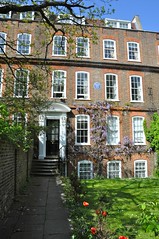
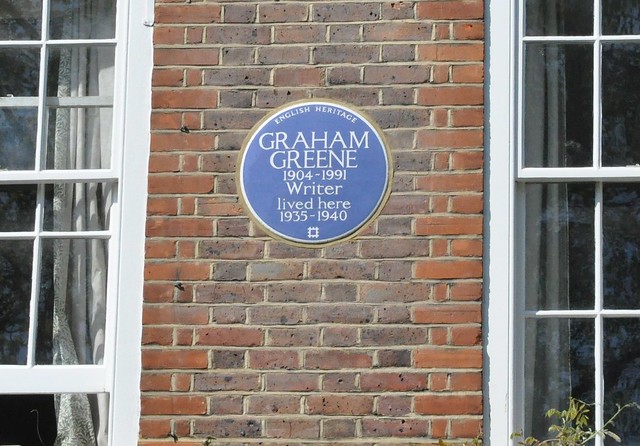
"Graham Greene (1904-1991) lived at 14 Clapham Common North Side from 1935 until he was forced to leave the house due to war damage in 1940. His novel The End of the Affair is set in Clapham in 1945-6. The narrator lives in a bedsit 'at the wrong side of the Common' (South Side), drinks in the 'Pontefract Arms' (The Windmill) and visits 'the dark church at the corner of Park Road - a Roman Catholic church full of plaster statues' (St Mary's). Writing to his mother, Greene describes Clapham thus: 'the whole appearance of Clapham Common is lovely, like a wide green plateau on a hilltop above Battersea with the Common stretching out in one direction and on three sides surrounded by little country-like shops and Queen Anne houses."
- from Clapham Past by Gillian Clegg
Greene lived here with his family from August 1935 to October 1940, when the house was bombed.
"The English Heritage blue plaque will be installed at 14 Clapham Common North Side, where Greene lived with his family from August 1935; at that time he described it as “a most beautiful Queen Anne house … done up absolutely like a museum piece”. It remained his home until October 1940 when it was hit in a bombing raid and became uninhabitable; the house was empty that night as Vivien and the children had been evacuated to Sussex and Graham was staying in Bloomsbury with his lover, Dorothy Glover. This devastating event later inspired the pivotal point in his novel, The End of the Affair. Despite the damage, the outer walls of the house remained intact, allowing the interior to be rebuilt after the war. The house is Grade II* listed and forms part of a terrace built by the architect John Hutt in 1714-20.
Greene’s daughter, Caroline Bourget, said of the house: ".... my father evacuated us to his parents' home in Sussex in August 1939 when I was only 5 yrs old......but I do remember the magnificent staircase. Some well-known writers and publishers visited the house such as John Betjeman and Evelyn Waugh. When I met them later, they recalled seeing me at the age of 3 or 4."
English Heritage blue plaque historian Dr Susan Skedd said: “Graham Greene is indisputably one of the great British writers of the twentieth century. He achieved the rare distinction of enjoying both critical and popular admiration throughout his career. Since the centenary of his birth in 2004 his literary reputation has been increasing and we hope this plaque will act as a focus for old and new fans of his work alike.”
This is the final post in this series looking at songs which made number one in the charts on my birthday. It been an interesting exercise, because I think it disproves the old chestnut "Pop is not as good as it used to be": every decade has thrown up classic songs as well as horrors. And the last 10 years has certainly seen some great songs that I'm pretty happy are in my birthday chart. So here is the final run down:
2002: Enrique Iglesias - Hero
Enrique comes across here as the male version of those power divas from the 90s, singing very much a power ballad. He looks good though.
2003: Christina Aguilera - Beautiful Disabled by request A gorgeous ballad by Christina - will this be a clasic? She succeeded Tatu as number one in 2003; they were the official on my birthday number one:
2003: Tatu - All The Things She Said
Hard to believe now this manufactured girl band were number one for a whole month. Great fun pop song though.
2004: Busted - Who's David
Huge in the mid-00s. Why? Oh wait. This trio completely passed me by; I have no recall of this song.
2005: Jennifer Lopez - Get Right
Stunning sounds and moves from Jenny from the block
2006: Meck ft Leo Sayer - Thunder In My Heart Again
"It wasn't just because it was a hot tune, it was all because "Oh my God, it's Leo Sayer" - Leo Sayer And Leo becomes the third artist to have two number ones on my birthday chart! - this time, almost three decades apart. Stunning achievement, Leo ( and great assistance from Meck)
2007: Mika - Grace Kelly
The next three hits are amongst my favourites of the last few years; amazing to think they all made number one around my birthday. Mika's video was another one directed by Sophie Muller (who did Shakespears Sister's Stay)
2008: Duffy - Mercy
Duffy's amazing voice and debut single livened up the beginning of 2008.
2009: Lily Allen - The Fear Embedding disabled by request How can anyone say Pop has dumbed down faced by this brilliance?
2010: Helping Haiti (Various Artists) - Everybody Hurts
I prefer R.E.M.'s original version, to be honest, but still this was in aid of a very worthy cause and it's great having something by R.E.M. in my birthday chart - they are one of my favourite bands.
And the final, most recent song, is:
Adele - Someone Like You
Words cannot express how thrilled I am Adele made it to number one with this astonishingly affecting song. She blew me away when she sang it on Later With Jools Holland last November - I pre-ordered her album on the strength of this performance - but I never imagined she would get to number one with it, even less so against Lady GaGa's hugely hyped Born This Way (which I have also bought!) Big congrats to Adele.
"Adele tickets are likely to become even more in demand as she has made history this week with her latest chart positions.
The singer has become the first artist since the Beatles to have two top five singles and two top five albums in the charts simultaneously.
Fans of the soulful singer appear to have been inspired to buy her latest single 'Someone Like You' after her Brit Award performance last week as her single jumped nearly 50 places to land the number one spot."
And that's all folks - thanks for coming with me on the journey :-)
Here we are in the 90s, the time when super divas roamed the earth. It is also another decade in which an artist scored two number ones on my birthday. Who do you think? Is it one of THEM? Time to find out.
1992: Shakespears Sister - Stay
I absolutely love this, and the video must be in my personal top three (it was directed by Sophie Muller). Just wonderful stuff. This stayed at number one for 8 weeks.
1993: 2 Unlimited - No Limit
"No no lyrics" - but this slice of Eurodance was the best-selling European song of 1993, and clearly popular in the UK too, as it reached number one. I sneakily quite liked it too.
1994: Mariah Carey - Without You The first of the super divas reigning supreme (Embedding disabled by request). Mariah takes the 1970 Badfinger song to number one again, and stays there for a whole month. Although it is possibly the most covered song of the last forty years, Badfinger themselves never released it as a single, not seeing its potential.
1994: D:Ream - Things Can Only Get Better
Maria was preceded as number one by D:Ream's biggest hit. The song achieved immortality as the theme tune to Tony Blair and New Labour's successful 1997 Election campaign.
1995: Celine Dion - Think Twice
. . . and the second super diva hoves into view. Celine's voice is of course incredible but this is surely a very poor choice of song: desperately cloying, sentimental, and obvious. I actually can't remember this at all; it must have passed me by completely in 1995.
1996: Babylon Zoo - Spaceman
A bit of an oddity, this: although it held the record for the most number of records sold in the first week of release, and stayed number one for a month. Jas Mann seems to have had bad luck with contracts which slowed down his subsequent career. Nice, very memorable debut though.
1996: Oasis - Dont Look Back In Anger
My 1996 birthday week saw Oasis's iconic song claim the number one spot, and mark out space for mid-nineties Britpop.
1997: No Doubt - Dont Speak
No Doubt's biggest international hit, featuring Gwen Stefani's stunning performance.
1998: Celine Dion - My Heart Will Go On
And here it is folks - Celine Dion's second outing in my birthday charts, singing the theme from THAT film. She was number one until the 22nd February, and on that day was superseded by:
1998: Cornershop - Brimful Of Asha
Cornershop reached number 60 in 1997 with this song, but Fatboy Slim's remix took them to number one in February 1998.
1999: Britney Spears - Baby One More Time Britney's stunning iconic debut video is disabled by request. A brilliant pop song, and one of the highest selling singles in the UK ever, it has already been covered by a multitude of artists, notably by Travis.
2000: All Saints - Pure Shores
The theme to the movie The Beach starring Leonardo DiCaprio, and witten by William Orbit and Shaznay Lewis, this was the first single off All Saints' second album (and one of the UK's best sellers of 2000). I remember the group single handedly made combat trousers fashionable in the late nineties.
2001: Atomic Kitten - Whole Again
Aww, poor Atomic Kitten! This was their real-life "save me" song, as Virgin Records wanted to drop them and were persuaded to release one more single. This was it. The record company was unwilling to plough any money into the video (hence the obvious cheapness), and finally, Kerry Katona dropped out of the band just days before the song charted, on account of her pregnancy. Well done in spite of everything!
So that's it for this decade, the last in this series coming up tomorrow.
My third decade of No.1 Birthday hits starts off with a classic:
1982: The Jam - A Town Called Malice
A bit controversial at the time, as EMI complained that as it was part of a 'double sided' single its aggregated sales were unfairly keeping their contender, Golden Brown by The Stranglers from reaching No.1. Life is tough.
1983: Kajagoogoo - Too Shy
The New Romantics are upon us! Kajagoogoo actually achieved a no.1 - this one - before Duran Duran ever did. Unfortunately it appears to have been their only one, and tensions in the band the band soon soon resulted in the lead singer, Limahl, being fired by his bandmates.
1984: Frankie Goes to Hollywood - Relax
Another iconic hit, notorious for being banned by the BBC at the time, and also for the scandalous original video, which only surfaced recently (the above is not it).
1984: Nena: 99 Red Balloons
In another amusing juxtaposition of styles and cultures, Frankie's raunchy number was followed immediately by Nena and her 99 red balloons.
1985: Elaine Paige and Barbara Dickson - I Know Him So Well
Tim Rice, Benny Andersson and Björn Ulvaeus teamed up to write the musical Chess and in the process wrote this mammoth hit for Elaine Paige and Barabara Dickson, which was number one for a whole month.
1985: Dead Or Alive: You Spin Me Round
After that, the country demanded something more energetic! - and got it with Dead Or Alive's classic. Apart from launching Pete Burns into the spotlight, the song was the first of many collaborations by Stock Aitken and Waterman.
1986: Billy Ocean - When The Going Gets Tough
Another song from the movies - this was the theme to The Jewel of the Nile starring Kathleen Turner and Michael Douglas.
1987: Ben E King - Stand By Me
History works in mysterious ways. This was originally released in 1961 - the year of my birth - and reached no. 27 in the UK charts. However, it recharted after the release of the movie Stand By Me in 1986 and went to no.1 in the UK following its use in a Levi's Jeans ad.
1988: Kylie Minogue - I Should Be So Lucky
I always think this was Kylie's debut but in fact it was her second hit. She flew to the UK to record with the by now ubiquitous Stock Aitken and Waterman. Apparently they forgot she was due to arrive and wrote this in 40 minutes while she waited in reception. She then recorded it in an hour. The rest is pop history.
1989: Simple Minds - Belfast Child
This beautiful song was written in the aftermath of the Enniskillen bombings.
1990: Sinead OConnor - Nothing Compares 2 U
Sinead's beautiful cover of the Prince song took it to worldwide prominence and launched her mainstream career.
1991: The Simpsons - Do The Bartman
Michael Jackson is another iconic figure who does not appear in my birthday charts. However. Michael wrote this (uncredited) because he loved the tv show. It went to number 1 in the UK but was never released in the USA.
And thus concludes my third decade - fourth coming up tomorrow.
So moviing on to my second decade of birthday week No.1 hits.
1972: Chicory Tip - Song of My Father
Chicory Tip probably hasn't remained in contemporary consciousness. But this, my friends, is real musical history. The song was co-written by Giorgio Moroder, no less, and is the first pop song to prominently feature a Moog Synthesizer.
1973: The Sweet - Blockbuster
Right - now we are in the era of Glam Rock. Sequins! Shiny! This was a massive hit for The Sweet.
1974: Suzi Quatro - Devil Gate Drive
Not I think one of Suzi's most memorable hits, but makes me think. By the end of Glam, Rock was clearly mature enough to allow for a consciously retro, nostalgic approach like this to work (with Suzi's gender being the contemporary twist). Also I wonder how much her look and attitude here fed into Punk a few years later? Fairly sure the Punks themselves would deny all influence!
1975: Steve Harley and Cockney Rebel - Make Me Smile (Come Up And See Me)
Good grief, just how sexy does Mr Harley think he is here? This is a lovely song though, and is probably still very familiar from its frequent use in tv ads, most recently for Marks & Spencer. It has also featured in two movie soundtracks: The Full Monty and Velvet Goldmine.
Steve Harley's birthday is the 27th February, so this was No.1 for him on his birthday in 1975.
1975 - Telly Savalas - If
Make me Smile was followed by Telly Savalas's If as No.1 - Telly making it as an add-on to his hugely succesful career as tv detective Kojak.
1976: Four Seasons: December 63 (Oh What A Night)
I loved this then, and it has stood up well to the passing of time. A remix charted in 1994.
1977: Leo Sayer - When I Need You
Leo Sayer, like Petula Clark, features twice in my Birthday No.1s! This was a huge hit for him at the time, reaching number 1 in both the UK and the USA. It was the first UK No.1 for its writer, Carole Bayer Sager. However, I feel it's all a trifle tedious and whiny now.
1978: Abba - Take A Chance On Me
But, hey! Abba! Woo!
If Armageddon swept away all late 20th-century popular music and left somehow only these blog posts, we would lose all the Beatles, Rolling Stones, Elton John and Rod Stewart - all massive artists who clearly neglected to have hits in late February. However, Abba saves the day. I was a total fan - this had to be kept somewhat under wraps from cool kid friends, who followed virtually every music critic at the time and dissed them. But ha! Time has vindicated the Swedish super group.
1978 - Kate Bush - Wuthering Heights
Abba was followed at No.1 in February 1978 but this extraordinary debut single by the legendary Kate Bush. Definitely a song one remembers.
1979: Blondie: Heart Of Glass
Was 1979 the greatest ever year in the history of the popular musuc charts? Judge for yourself.This is the amazing Blondie's debut smash.
1979 - The Bee Gees - Tragedy
Followed on immediately by the Beegees! The melodrama of this one has always thrilled me.
1979 - Gloria Gaynor - I Will Survive
And the Beegees were followed by this all-time classic by Gloria Gaynor! Honestly, from the Village People to Pink Floyd, 1979 has got it all!
1980 - 1980: Kenny Rogers - Coward Of The County
Down to earth with a thump. Yuck. The obvious sentimentality took this one to No.1, it can't disguise the nastiness now. It deserves oblivion.
1980 - Blondie - Atomic
However, Kenny Rogers was followed quickly by another terrific Blondie effort.
1981: Joe Dolce Music Theatre - Shaddap You Face
Another very efficient novelty number, in grand pop fashion being followed by the sublime:
1981 - Roxy Music - Jealous Guy
Was this the greatest cover ever made? I always think that Bryan is singing about Jerry, but in fact she had left him for Mick three years previously. Anyhow, he sings it with total conviction.
And another ex-Beatle, John Lennon, makes it into my Birthday charts (albeit as the writer) - posthumously, sadly.
Well, that concludes my second decade on an extremely high artistic note: what does decade three have in store? Find out tomorrow!
One of my dearest friends has a blog entitled Fast Approaching Fifty. I've always been in awe at her frankness, because I too am fast approaching fifty and am severely in denial about it. So maybe the time has arrived for me to come out and say I'm fabulous and (about-to-be) fifty! Yikes!
Since it is obviously way too late for me to have a whole blog dedicated to the subject, I thought I could do series of mini-blog posts counting down to this significant event, which is in 5 days' time. I've lived through a half-century of pop music. I thought it would be fun to do a count-down of every No. 1 song in the charts during my birthay week, over the last five decades. I'll do a decade every day, five posts in all, with the last on my birthday. It will be a little snapshot of musical history; a cross-section through time.
So here goes.
1961 - Petula Clark: Sailor
I imagine the nurses were humming along to this tune in my mother's maternity ward back in February 1961. Interesting fact: Petula Clark features twice in my personal charts, and neither time is her song "Downtown" or "Don't sleep in the Subway", the two songs for which she is principally remembered today. Petula actually had a major career in the 50's before she reinvented herself as a 60's pop star. This song definitely harks back to her 50's heyday, and makes me feel positively prehistoric.
1962 - Elvis Presley: Rock a Hula Baby
But hey! Rock was young! And Elvis was in the building. Strangely though, this lesser Elvis hit feels almost as if his handlers were desperately trying a new angle on Rock - as if they felt it was a fad they had to keep going as long as they could. This was from one of Elvis's movies, and is the first representative of quite a slew of movie-music hits in my charts.
1963 - Frank Ifield: Wayward Wind
Another dinosaur. *Blocks ears*
Frank was actually the first artist to have three UK No.1 hits, and was last in the charts as recently as 1990, with "She Taught Me to Yodel".
1964 - The Bachelors: Diane
Ok I've heard of the Bachelors. Didn't they use to hang out with Cliff Richard? Not a song that has lasted well.
1965 - The Kinks: Tired of Waiting for You
I'm going to cheat a bit here (but hey it's my birthday so I can). The Kinks were officially No.1 on the 22nd February 1965 (and a great classic British band they are too); but more importantly for my personal development the No.1 on the very next day, the 23rd February, the day after by birthday, was:
1965 - The Seekers: I’ll Never Find Another You
This was the very first gig I (almost) went to! Oh, the excitement! As I recall, our neighbour's teenage daughter, my babysitter, thought it would be an excellent idea to take the four-year-old me along to a Seeker's concert. I was thrilled to bits. However, my mum thought it was way too past my bedtime and I was grounded :-(
The Seekers were an Australian band and absolutely mega for a brief period mid-sixties. You can hear the way their folk sound fed into the nascent hippy movement.
1966 - Nancy Sinatra: These Boots are Made for Walking
Definitely the most iconic pop song in my charts so far. Nancy Sinatra was pretty much a one-hit wonder, but what a magnificent hit to have.
1967 - Petula Clark: This is My Song
And here we have the second Petula Clark song in my chart, and also the second to come from a movie. Written by Charlie Chaplin, no less. I've chosen the French version here because I think it sounds better. Check out Petula's mini!
1968 - Manfred Mann: Mighty Quinn
Meanwhile, the hippy thing is starting to go a bit psychedelic here. A classic song and performance, but has never done anything much for me.
1969 - Amen Corner: Half as Nice
Another little cheat coming up - Amen Corner were No.1 on the 22nd '69, but Peter Sarstedt took over on the 25th, and stayed no.1 for the next month.
Appealing stuff, Amen Corner - I was into this; hasn't really lasted.
1969 - Peter Sarstedt: Where Do You Go To My Lovely
But Peter Sarstedt's song is a classic! Sentimental and a bit kitsch, this was the ultimate in sophistication when I was 8. Many years later, my first visit to the Boulevard St Michel brought me out in goosebumps.
1970 - Edison Lighthouse: Love Grows Where My Rosemary Goes
The happy innocent hippy vibe lives on! Love this, but perhaps you had to be there at the time :)
1971 - George Harrison: My Sweet Lord
The archetypal hippy song, and the only Beatle to feature in my charts. A worthy climax to my first decade!
. Like a child outgrowing its toys, London has its very own transitional object: the London Stone. The city has clung onto this object for so long it has forgotten why it was important in the first place: fertile ground for urban legends to flourish.
“Already a subject of speculation in the 16th century, subsequently identified in turn as a Roman milestone, as a Druid monument, as the ‘Stone of Brutus’ and as ‘London’s original fetish stone’, it is now considered by some to play an essential role in the ‘sacred geometry’ of London. How have such diverse opinions as to its purpose arisen? – and can we truly identify its date and its original function?”
Apparently it’s on very important ley lines; it may have been part of an ancient megalith circle; it is reputedly the fountain of authority in the city; it protects the city from harm. And it is does all this from a frankly grim spot on Cannon Street across from the station - housed in a dirty little wrought-iron shrine at ankle height, built into the side of a shortly-to-be redeveloped shop. Sad and crumbling and no different to any other lump of stone you’ve ever come across.
It’s documented way back (mentioned by Shakespeare, no less), and according to John Clark (the former Senior Curator (Medieval) at the Museum of London) was sited in a very interesting location in the geographies of both Roman and Anglo-Saxon London. However, the Enlightenment in its arrogance moved it (all?) out to the side of the road and the Victorians bricked it up in the side of a church. Oh, and completely removed all archeological trace of its original site when Cannon Street was cut-and-covered for the Circle Line.